

Media and Democratic Backsliding: A Multidimensional Conceptual Analysis
Morechay, N. & Barhum, S. (2026). Media and Democratic Backsliding: A Multidimensional Conceptual Analysis. Media Frames, 28. https://doi.org/10.57583/MF.2026.28.10106
תקציר
המאמר מציע מסגרת קונספטואלית חדשנית להבנת הקשר המורכב בין תופעת הנסיגה הדמוקרטית (Democratic Backsliding) ובין שדה התקשורת. נסיגה דמוקרטית היא תהליך מוסדי־פוליטי הדרגתי ורב־מישורי, שבו השלטון מבקש לצבור כוח באמצעות לכידה שיטתית של מוסדות המדינה והמרחב הציבורי. המאמר מרחיב את הספרות הקיימת בנושא, שהתמקדה במוסדות חוקתיים, ומציג מודל טיפולוגי המראה כיצד תהליך הנסיגה הדמוקרטית בא לידי ביטוי בהשפעה על התקשורת במדינה, על מרכיביה השונים, ואף בהשתלטות עליה.
הטיפולוגיה המוצעת – המכונה “פלייבוק” לצעדים המשנים את מאזן הכוחות בין השלטון לתקשורת – מתבססת על ראיית התקשורת כמערך מוסדי מבוזר ורב־שחקנים, בשונה ממוסדות חוקתיים ריכוזיים, ולכן מחייב ניתוח הוליסטי. המאמר פורס שורה של מישורים ומנגנונים טיפולוגיים של נסיגה דמוקרטית בתקשורת, ובהם: תנאי רקע סוציו־פוליטיים של פופוליזם; פגיעה בשידור הציבורי; פוליטיזציה במינויים של בעלי תפקידים; לכידה רגולטורית ושינוי מבני של שוק התקשורת; ריכוזיות והטיית משאבים כלכליים בתקשורת המסחרית; מעקף התקשורת המסורתית באמצעות הרשתות החברתיות; וכן יצירת אקלים של עוינות כלפי עיתונאים, המעודד צנזורה עצמית. תהליכים אלה, הפועלים במקביל ובאים באינטראקציה זה עם זה, מובילים לארגון מחדש של המרחב התקשורתי באופן המשרת את האינטרסים השלטוניים, ואף מאפשרים היזון חוזר המעמיק את הנסיגה הדמוקרטית.
תוך התבססות על ספרות מתחומי התקשורת, לימודי דמוקרטיה והמשפט הציבורי, המאמר מבקש להרים תרומה תיאורטית כפולה. ראשית, פיתוח טיפולוגיה רב־ממדית של נסיגה דמוקרטית בתקשורת, אשר ממפה באופן שיטתי וכוללני את האפיקים השונים שבאמצעותם השלטון עשוי לפגוע בעצמאות התקשורת – אפיון שנעזר בתיאוריה ובניסיונן של מדינות רלוונטיות, ושיאפשר מחקרי תקשורת השוואתיים לזיהוי דפוסים חוצי מדינות. שנית, המאמר רותם את המודל הטיפולוגי המוצע כדי להראות שהוא רלוונטי ביותר גם בישראל של העת הנוכחית, ואף יותר מכך – שניתן להבחין בתהליכים של נסיגה דמוקרטית אף בעבר הקרוב. בכך, הוא מצרף את ישראל למקרי המבחן שהספרות דנה בהם בהקשר הזה.
Abstract
The article advances a novel conceptual framework for analyzing the complex relationship between democratic backsliding and the media. Democratic backsliding is understood as a gradual, multilayered institutional and political process through which government seek to accumulate power by systematically capturing state institutions and reshaping the public sphere. Building on this body of literature, which has largely focused on constitutional institutions, the article develops a typological model demonstrating how processes of democratic backsliding manifest themselves in attempts to influence, constrain, and ultimately control the media across its various components.
The proposed typology—conceptualized as a “playbook” of measures that recalibrate the balance of power between the government and the media—conceives of the media as a decentralized, multi-actor institutional arena, distinct from centralized constitutional bodies and therefore requiring a holistic analytical approach. The article delineates multiple dimensions and mechanisms of democratic backsliding in the media, including: the socio-political background conditions of populism; the erosion of public broadcasting; the politicization of appointments to public office; regulatory capture and structural transformation of the media market; concentration and strategic allocation of economic resources within the commercial media sector; the circumvention of legacy media through social media platforms; and the cultivation of hostility toward journalists which, in turn, encourages self-censorship. Operating simultaneously and interactively, these processes restructure the media environment in ways that serve governing interests and generate feedback loops that further entrench democratic backsliding.
Drawing on scholarly literature in the fields of media studies, democracy studies, and public law, the article seeks to make a dual theoretical contribution. First, it develops a multidimensional typology of democratic backsliding in the media that systematically and comprehensively maps the various channels through which governments may undermine media independence—an account informed by theory and by the experience of relevant countries, and one that can facilitate comparative media research aimed at identifying cross-national patterns. Second, the article employs the proposed typological model to demonstrate that it is highly relevant to contemporary Israel and, moreover, that processes of democratic backsliding can also be discerned in the recent past. In so doing, it adds Israel to the cases examined in the literature in this context.
Introduction
This article characterizes a range of phenomena concerning the relationship between democratic backsliding and the media. The identification of the various dimensions through which the relationship between media and democracy may be analyzed is grounded in the paradigm of democratic backsliding (Bermeo, 2016). Democratic backsliding refers to the erosion of democratic values and institutions pursued by those in power, thereby transforming the democratic model within a given state.
Democratic backsliding is evident across numerous countries as part of the broader “global democratic recession” (Lührmann & Lindberg, 2019), with research indicating that its severity varies across democracies (Wolkenstein, 2022). Until recently, scholarship on democratic backsliding focused primarily on mapping and assessing how governments seek to capture constitutional institutions, with particular emphasis on processes of executive aggrandizement at the expense of checks and balances, constitutional change, judicial capture, and the contraction of the liberal sphere (Huq & Ginsburg, 2018; Scheppele, 2018; Haggard & Kaufman, 2021).
Today, democratic backsliding is understood as a wider process that extends beyond the constitutional domain and encompasses the transformation of additional social institutions in undemocratic directions, including, for example, culture, civil service and academia. More recently, scholarship has begun to examine the relationship between democratic backsliding and the media. This emerging body of research seeks to map the various channels through which governments may undermine the media landscape as part of anti-democratic ambitions and broader efforts to accumulate and consolidate power at the expense of state institutions, private actors, and the public sphere.
Against this backdrop, this article pursues a dual objective. First, it seeks to construct a typology of democratic backsliding in the media by identifying characteristic measures undertaken by governments seeking to erode media independence across multiple dimensions, which, cumulatively, amount to democratic backsliding in the media sphere. The article maps a series of relational dimensions between government and media, demonstrating how governments attempt to alter the balance of power between them. These processes have not yet been comprehensively conceptualized. The proposed typology thus expands the existing body of research and offers a structured account of democratic backsliding as it pertains to the media.
Second, the article situates the Israeli case along the continuum of democratic backsliding in the media. Following the presentation of each component of the proposed typology, brief references are made to Israeli contexts that indicate governmental aspirations to curtail media independence and, at times, to take control of it.
Analyzing the relationship between media and democratic backsliding yields two principal contributions. The first lies in enhancing scholars’ ability to identify the multiple dimensions through which this process may unfold and to construct a comprehensive analytical picture that captures its severity. We argue that only a holistic perspective on the relationship between media and government enables such an analysis, rather than an inspection of individual governmental initiatives in isolation. For example, reforms in public broadcasting—often placed at the center of contemporary discourse, particularly in Israel—should not be assessed in isolation from broader transformations. Rather, they must be evaluated cumulatively, including in relation to developments in the commercial media sector and the press market.
The second contribution concerns the Israeli case itself. It appears that, even in Israel, clear anti-democratic indicators typically associated with backsliding democracies can readily be identified. The article therefore offers a conceptual framework that will enable future reassessment of Israel’s position along the continuum of democratic backsliding.
A. Democratic Backsliding: Preliminary Socio-Political Processes
The presence and intensity of democratic backsliding across different states are difficult to measure (Little & Meng, 2024; Knutsen, 2024). On the one hand, one may point to “former democracies,” in which this process has already eroded democratic resilience, such as Turkey and Hungary (see Bajomi-Lazar & Stępińska, 2019; Benedek, 2024; Polyák, 2019), as well as additional countries in Central and Eastern Europe (CEE). On the other hand, in other states, the process is non-linear, and episodes of democratic erosion coexist with governmental turnover and the reaffirmation of the rule of law (e.g., Poland and Brazil).
Nevertheless, at the institutional level, democratic backsliding is characterized by patterns of governance aimed at increasing control over the institutions and sectors of liberal democracy. The media constitutes one such institution.
A typical process of democratic backsliding is marked by the prolonged rule of one side of the political spectrum, which succeeds in maintaining its dominance over time while adopting populist approaches to shaping the governmental and public spheres. Such a regime will seek to influence the political and public domains in its favor, with the aim of preserving its tenure and rendering the ideologies and values it promotes hegemonic. Unlike a coup or overt regime change, democratic backsliding is an internal, gradual, and politico-institutional process in which power is accumulated through the systematic capture of both formal and informal state institutions.
This process begins with the growing political and cultural influence of one side of the political spectrum. It then encompasses both attempts to capture the state’s formal constitutional framework and successful efforts to do so, as well as the gradual institutional aggrandizement of the executive through informal constitutional means, involving measures that enhance its power at the expense of independent authorities, institutions that provide checks and balances, or other liberal spheres (Luo & Przeworski, 2023).
These developments constitute preliminary background conditions for the expansion of democratic backsliding into the media sphere. As noted, the prolonged rule of a single political bloc, coupled with socio-political conditions that enable such continuity, leads first to constitutional transformation centered on the empowerment of the executive at the expense of institutions that provide checks and balances. Subsequently, the government will seek to capture additional state institutions, such as the civil service. Concurrently, and at various stages of the backsliding process (sometimes at its outset and sometimes at its height), the government will turn its attention to the media—either to consolidate prior processes of control and influence or to directly dominate it.
B. A Complex Characterization of Democratic Backsliding in the Media: The “Playbook”
The following sections present a series of defining characteristics—the “typological playbook”—of democratic backsliding in the media. These characteristics reflect non-democratic processes unfolding within the media market, with varying intensities and sequences of development, throughout the course of democratic backsliding. Their articulation provides a conceptual foundation for a systematic inquiry into whether democratic backsliding as manifested in the media is taking place in Israel, or in any other state examined through the lens of the proposed typology.
For example, although recent legislative proposals in Israel have placed public broadcasting at the center of public discourse as a focal point of media capture—both in Israel and elsewhere (Neff & Pickard, 2024)—we contend that attention must also be directed toward additional channels (Štětka & Mihelj, 2023), including ownership structures within the media market, the politicization of appointments to regulatory bodies, and journalists’ self-censorship.
We argue that a process of institutional democratic backsliding will also entail governmental aspirations to influence or capture additional social institutions that shape the public sphere. The government will identify targets such as the civil service, academia, institutions of culture and art, as well as economic and commercial bodies, and seek to advance its ideology and interests through them. As part of this broader trajectory, the media—namely, commercial media, the digital sphere, and public broadcasting—will become a central target of governmental influence and potential capture (Çelik et al., 2024).
Furthermore, we contend that democratic backsliding in the media may be more complex and multidimensional than in other institutional contexts. This is not a straightforward institutional scenario in which an “empowered executive” confronts “the media” as a unified entity. Nor is it analogous to a single constitutional court, where once loyalists are installed, control over constitutional interpretation becomes nearly absolute. In contrast to the senior constitutional institutions that an ascendant government seeks to capture, the media field is characterized by a far more decentralized configuration of forces, actors, and organizations—both on the side of the executive and among the various media entities. Accordingly, democratic backsliding in the media must be examined through a holistic, multi-layered institutional perspective.
From the governmental side, the arenas of intervention in the media are numerous and include the Minister of Communications, the head of the executive branch himself (and his patronage), government ministries, the legislature, and captured regulators. From the media side, the environment is equally decentralized, comprising multiple actors with diverse interests, some of which may align with governmental capture strategies.
Recent scholarship has begun to identify the mechanisms through which governments attempt to shape the media (McDevitt, 2022; Över, 2021). Research on this phenomenon in the Israeli context is also emerging, with growing recognition of the connection between democratic backsliding in general and its manifestations in the media in particular. However, this field of research remains in its early stages (Ben-David et al., 2025).
In the present article, we characterize and analyze several typical channels through which this process unfolds, drawing on the evolving literature in the field (Culloty & Suiter, 2021). To facilitate a more comprehensive understanding, and building upon the typology proposed by Dragomir (2019), we introduce a conceptual framework and typology of the phenomenon, presented in Table A, whose features will be elaborated upon in the sections that follow.
Table A: Media and Democratic Backsliding – Typology
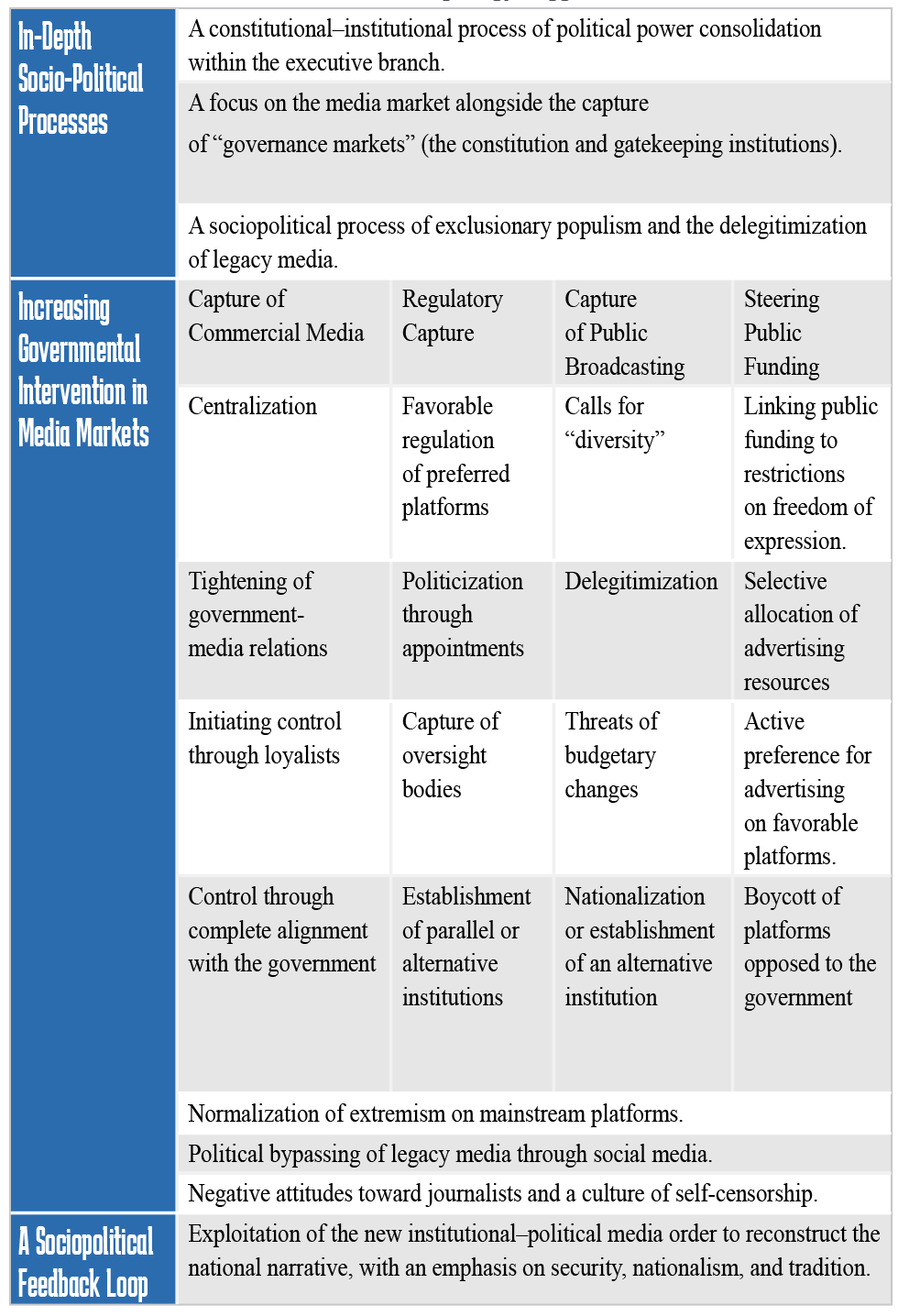
The various dimensions set out in the table constitute the “typological playbook” of democratic backsliding in the media, drawing on the experience of different democracies. Democratic backsliding in the media unfolds within broader socio-political deep-structural dynamics. It is characterized by increasing governmental intervention in key areas of the media system: commercial media, media regulation, public broadcasting, and the allocation of public funding. Within each of these domains, one can identify processes of progressively intensified state involvement, culminating, in the most severe cases, in sectoral capture.
At the same time, democratic backsliding in the media is characterized by several additional processes, foremost among them the political bypassing of legacy media through social media; the normalization of extremism on mainstream media platforms; and the emergence of negative, and at times openly hostile, attitudes toward journalists and media outlets. As these processes develop across the various domains outlined in the table, they ultimately contribute to a reorganization of the media system and of journalistic practice in ways that increasingly serve the interests of the governing authority. This process is accompanied by a feedback loop that, in turn, enables democratic erosion to deepen across additional arenas. The following sections examine these processes in detail.
B.1 Exclusionary Populism and the Delegitimization of Legacy Media
Media-related democratic backsliding often emerges in the wake of the establishment of populist politics (Manucci, 2017). Populism constitutes a socio-political background condition within which various institutional processes unfold, including the emergence of governmental efforts to capture the media and channel it toward the preservation of its rule. As part of a broader populist ideology, a process of media delegitimization takes place, reflecting the broader relationship between populist politics and both formal and informal state institutions. The government portrays major media outlets as elitist, politically biased, saturated with class-based and hegemonic interests, and acting against the will of the public. Governmental rhetoric thus constructs a distinction between “the people” and “media elites.”
Such polarizing populist rhetoric toward the media is difficult to address through existing policy tools, even as it fosters the unfair treatment of the media and contributes to its portrayal as an institution undeserving of independence. In this vein, the populist narrative broadly portrays “the media” as an institution aligned with other social elites, one that undermines the government’s mandate and harms the “morale” of “the people.” The long-term objective of this effort is to erode public trust in legacy media and weaken its independence. The populist narrative thus provides a foundation for governmental control over media platforms, legitimizing the capture of existing outlets or the establishment of media platforms aligned with governmental interests. Populism can therefore be understood both as a broad socio-political phenomenon underlying media-related democratic backsliding and as fertile ground for its further expansion.
To properly understand populism, it is important to note that it is a supra-political and ideologically neutral phenomenon in terms of its substantive content. Populism may assume a right-wing ideological orientation, but it may also be aligned with clearly left-wing economic or social ideologies. In Israel, political developments over the past two decades have contributed to the rise of an ethno-nationalist-security populism promoted and amplified by the political right. Populism is only one component shaping the ways in which the government seeks to structure the state; a right-wing government may employ populism to reduce public trust in social and state institutions and to delegitimize them.
It should be noted that the question of trust in the media is complex even independently of the current democratic crisis. Political polarization and existing social structures affect levels of public trust in the media. One could argue that trust in the media was initially low, thereby necessitating policy responses and direct governmental involvement in the media. Alternatively, it is possible that the populist attack on the media is itself a cause of declining trust. Our argument is that the populist leader and his political rhetoric promote strong public claims of distrust toward legacy media, allegedly portraying it as betraying the interests of “the people,” and that these claims are then used by the government as a pretext for attempts to capture media institutions, while simultaneously further intensifying their delegitimization.
In Israel, one can identify a long-term process that began years before the 2023 regime shift, whereby the media was portrayed as a left-wing elite saturated with class-based and hegemonic interests (similar to the judicial system) and as engaged in a struggle against the elected representatives of “the people” (Rogenhofer & Panievsky, 2020).
B.2 Erosion of Public Broadcasting
The most immediate and accessible tool enabled by the populist narrative against the media is the erosion of the legitimacy of public broadcasting, extending to explicit calls for its abolition and initiatives aimed at achieving this goal (Holtz-Bacha, 2021). Alternatively, populist leaders may seek to bring public broadcasting under their control, a pattern characteristic of democracies in more advanced stages of democratic backsliding. Examples include democracies in Central and Eastern Europe (CEE countries; see Appendix A), where governments have sought to capture public broadcasting in the early stages of governmental entrenchment. However, even in more robust democracies where publicly funded public broadcasting exists—such as the United Kingdom, Sweden (Hien & Norman, 2023), Denmark, Switzerland, and the United States—ongoing struggles persist over its continued existence and independence (Połońska & Beckett, 2019). Within this context, several governmental strategies for controlling or undermining public broadcasting institutions can be identified:
B.2.1 Disregard and Delegitimization
Even in countries where the threat to democracy is not perceived as severe, populist leadership may disregard the necessity (or even the legitimacy of its existence) of public broadcasting, express doubts about its utility and the justification for its funding, and use state power to constrain its operations. Such measures are typically presented publicly as being motivated by social considerations. Populist leaders amplify narratives alleging a lack of balance and diversity in the media generally, and in public broadcasting in particular, which is expected to represent “the people” who finance it rather than merely elite interests.
In most cases, the motivation for delegitimizing public broadcasting is political and stems from governmental dissatisfaction with its editorial coverage. Public broadcasting is particularly vulnerable to delegitimization efforts because it is state-funded. For example, former British Prime Minister Boris Johnson engaged in an open political confrontation with the BBC, the UK’s public broadcaster. This conflict influenced the attitudes of Johnson’s supporters, both moderate and hard-right, toward the institution. Johnson’s rhetoric included amplifying public debates over alleged bias in political coverage, which contributed to broader questioning of the corporation’s necessity and of the justification for its license-fee-based funding model. Accordingly, Johnson often adopted an “empty chair” policy, refusing to be interviewed by the BBC.
B.2.2 Budget Cuts
A further stage in the erosion of public broadcasting involves the use of budgetary instruments to curtail the scope of its activities. In several Western European countries, funding models continue to rely on license fees, and in recent years, some governments have pursued policies aimed at reducing or abolishing such fees. In countries where public broadcasting is funded through the state budget, proposals have likewise emerged to increase governmental control over public broadcasters’ budgets or to reduce their allocations, thereby facilitating direct political intervention in their operations.
For example, in Denmark—a country not characterized by advanced democratic backsliding—a proposal was adopted to reduce the public broadcaster’s budget by 20%, resulting in a reduction in both the scope of its operations and its workforce. In Israel, current efforts by the Minister of Communications seek to weaken the financial stability of the Israeli Public Broadcasting Corporation, raising concerns about reduced independence and a diminished capacity for content production.
Legislative bills on the issue also tend toward greater government involvement. In 2023, a bill was introduced to strengthen political oversight of the broadcaster’s budget (Israeli Public Broadcasting Bill, 2023), while in 2024, another bill sought to eliminate the corporation’s independent budgetary management and place it under the state budget (Israeli Public Broadcasting Bill, 2024). This bill continues to advance (April 2026).
The weakening of public broadcasting in Israel is also important to the government because the institution serves as a barrier to concentration in the media market (Ben-David et al., 2025, p. 40). When public broadcasting is weakened, this facilitates the takeover of frequencies by private actors, some of whom may have close ties to the government, and constitutes another mechanism that benefits politicians engaged in democratic backsliding.
B.2.3 Nationalization Through Appointments or Legislation
Another pathway through which governments may seek to control public broadcasting is its nationalization. Nationalization refers to the complete elimination of the distinction between an independent public broadcaster and the government. This can be achieved through several mechanisms, the most common of which is the replacement of personnel within the public broadcasting institution with individuals perceived as loyal to the governing authority.
Such processes have been pursued in several Central and Eastern European countries characterized by advanced democratic backsliding. For example, following the electoral victory of Hungary’s Fidesz party in 2010 and through 2015, more than 1,600 journalists and media professionals were dismissed from public media and replaced with employees considered more loyal to the government’s narrative. This large-scale replacement brought about a profound structural transformation, through which public media lost its independence and became an entity controlled by the government, thereby strengthening the state’s capacity to shape media content and the public discourse (Nemeth, 2025, p. 17).
Another way of taking control of public broadcasting is to undermine its independence through legislation, in ways that impair its ability to provide the public with high-quality and diverse offerings (content, documentaries, and news). A common means of implementing this in democracies experiencing democratic backsliding is to alter the definition of the purposes (objectives) of public broadcasting in its enabling legislation.
B.2.4 A Parallel or Subordinate Broadcasting Body
Another practice involves the creation of a new public broadcasting entity or supervisory authority that effectively neutralizes the existing public broadcaster.
For example, in Poland, legislation led by the Law and Justice Party (PiS) established a new entity (NTC), which was granted supervisory authority over the public broadcaster, with its leadership appointed by the government (Surowiec et al., 2021). Subsequently, the legal mandate of the new body was revised to emphasize national, religious, and other ideological objectives aligned with the party’s agenda, contradicting the principle of press independence (Węglińska et al., 2022).
In Hungary, public media is directly controlled by the government, and operates without any independence whatsoever. A 2010 media reform restructured the regulatory framework governing the media market. The National Communications Authority and the National Radio and Television Commission were merged into a single body, the National Media and Info-communications Authority (NMHH), which was granted oversight over both print and electronic media. The NMHH includes the Media Council, which is responsible for licensing, content regulation, and enforcement of media laws. The government exercises full control over appointments to both the authority and the council.
In 2011, the Fidesz government further transformed the media landscape by transferring all public broadcasting assets to the state fund MTVA (Media Service Support and Asset Management Fund), operating under the NMHH and the Media Council. News content, funding, asset management, and operational control of public broadcasters were centralized under MTVA, and, since 2015, also under the unified broadcaster Duna Media. Although the fund’s annual budget is approved by parliament (controlled by Fidesz), the NMHH Media Council determines governance rules and resource allocation, resulting in direct political control over the content and financing of public media. This deepened dependence on the government, weakened institutional independence, and generated international criticism regarding declining pluralism and balance in news coverage (McNeill & Valentine, 2024). This represents the most advanced stage of direct governmental control, characterized by the absence of any institutional buffer or any degree of independence.
B.2.5 Privatization
A fifth strategy involves the privatization of public broadcasting. This approach is justified by governmental claims that there is no rationale for funding public broadcasting, although in practice it often stems from an underlying desire to control the ownership structure of the newly privatized entity. Privatization is sometimes perceived as a substantive and symbolic intervention and may therefore face stricter scrutiny from institutional checks and balances, on the assumption that their authority has not yet been undermined. In contrast, gradual and cumulative initiatives that erode the broadcaster’s independence tend to encounter weaker legal resistance.
In Israel, current policy favors public debate of this type of privatization model. In recent years, the government has consistently and systematically introduced bills to privatize public broadcasting, both with respect to the Israeli Public Broadcasting Corporation (Public Broadcasting Corporation Privatization Bill, 2022, 2024) and the Israel Defense Forces Radio station, Galei Tzahal (IDF Radio Privatization Bill, 2022, 2023, 2024). The most recent bill to date, from late 2024, seeks to stipulate that the public broadcasting corporation will cease to exist two years after the law enters into effect. More recently, the government decided to shut down Galei Tzahal (Government Resolution 3661 of the 37th Government), A move that was ultimately blocked only due to a Supreme Court ruling invalidating its legality (HCJ 61683-12-25).
The full set of strategies outlined above with respect to public broadcasting provides a framework for identifying and interpreting governmental actions in the context of media-related democratic backsliding. Experience shows that governments may adopt a range of policy measures that serve the same overarching objective—the politicization of public broadcasting—albeit with varying levels of intensity.
In Israel, the government has consistently brought forward far-reaching bills to privatize the public broadcasting corporation, a course of action characteristic of flawed democracies undergoing advanced democratic backsliding. However, some of these bills have not advanced rapidly, particularly when compared with the pace of public broadcasting capture in Central and Eastern European countries. These initiatives function both as an ongoing threat to the operation of the public broadcaster and as a form of symbolic political signaling.
B.3 De-Regulation for Government-Aligned Platforms
Another mechanism for strengthening media control involves regulatory bias in favor of platforms that are supportive of the government. This approach falls within the conventional domain of media market regulation and is typically framed in terms of legitimate policy objectives, such as media pluralism and the representation of diverse public voices. In practice, however, its underlying aim is to promote favorable media coverage of the government.
In Israel, attempts have been made to shape television broadcasting in favor of government interests through regulation. Examples of regulatory favoritism that contributed to the rise of government-aligned platforms include the emergence of the newspaper Israel Hayom (and subsequent legislative attempts, first to facilitate its continued operation through special legislation and later to restrict its free distribution through further legislation; Globes, 2019), as well as Channel 14, which began broadcasting as a “National heritage” channel and later evolved into a news channel with the support of regulatory and financial benefits.
In parallel, there has been an ongoing struggle over appointments to regulatory authorities, with the government appointing controversial figures to key positions in an effort to secure favorable regulation. The underlying objective of these appointments is to exert control over media oversight through political influence over regulatory institutions.
Israel, particularly since 2023, has seen far-reaching legislative initiatives proposed by the government that seek to alter the democratic balance of checks and balances within institutional frameworks. Moreover, since 2024, there has been growing concern that the government is advancing a broad reform intended to tilt the media market in its favor. Prominent in this context is the Communications Bill (Broadcasts) from mid-2025, a government-sponsored bill being rapidly advanced by the Minister of Communications and currently debated in an ad hoc parliamentary committee established specifically for its passage.
Symbolically, this bill represents another step in a broader sequence of actions by the Minister of Communications, all of which are presented as part of a declared effort to bring about a “revolution” in the broadcasting market. This objective is characterized by a vision of dismantling the existing “centers of power” among established media actors and institutions. The bill is being advanced rapidly, without systematic preparatory work involving all relevant stakeholders and government ministries, and merges multiple elements of reform—some of which have already been proposed but not enacted—into a single legislative package. This raise concerns that the process is being used to undermine the independence and resilience of media outlets.
At present, the bill’s advancement has faced opposition from legal gatekeepers within the government and the Knesset, on the grounds that it includes components that undermine democratic checks and balances. Despite this opposition, the government bypassed the Knesset Economic Affairs Committee in order to neutralize its chair’s opposition and established a special ad hoc committee to advance the bill—an unprecedented move that undermines the principle of separation of powers. At the time of writing, amid the ongoing campaign against Iran, an intensive legislative process is underway that has already pushed government intervention in the media market to unprecedented levels since the establishment of the state. This raises significant concerns regarding deficiencies that, it has been argued, justify unprecedented judicial intervention during the legislative process (Bar-Siman-Tov et al., 2025).
A fundamental component of the bill concerns the establishment of a new regulatory authority by the government, raising concerns that, as with the civil service, this authority would be established solely to increase political control over the existing regulatory system, similar to measures undertaken in Hungary and Poland. The bill includes the removal of mechanisms that safeguard the independence and autonomy of news broadcasting, thereby enabling political and economic intervention in such broadcasts by interested parties. It raises concerns regarding political affiliations in the appointment of public representatives to the new regulatory authority, owing to the structure of the appointments committee to be established and to the fact that the authority’s budget would not be independent but rather part of the state budget. In addition, the bill under consideration contains a distinct element of politicization with regard to ratings data, through a provision that would allow the new authority to intervene in the way such data is measured. These features led the Attorney General to issue an unusually strong and unprecedented warning about the bill’s potential to undermine the democratic checks and balances of Israel’s broadcasting market.
Another example of this characteristic is the attempt to exert political control over the regulation of audience ratings. A recent bill seeks to require television channels to display their real-time viewership data during peak viewing hours (Audience Data Disclosure Bill, 2024). Beyond the problem of the “reality-televisionization” of viewing, the bill seeks to flatten television viewing and diminish its value for freedom of expression. This represents a new form of tele-populism emerging in Israel against the backdrop of political disagreements between Channel 14 and the other channels regarding their relative influence and viewership figures.
B.4 Political Involvement in Commercial Ownership Structures
Another central phenomenon that can be identified as a foundation for potential political capture of the media is increasing political involvement in the ownership structure of commercial media, including the exploitation of market concentration and monopolistic ownership structures to transform media into an instrument serving political actors. This phenomenon has several dimensions.
In democracies undergoing democratic backsliding, there is a growing tendency to pressure international corporations to exit domestic media markets and cease providing services, with the aim of enabling nationalization or encouraging domestic actors aligned with the government to acquire media companies, as has occurred in Central and Eastern Europe (Dragomir, 2019). Such democracies are also characterized by cross-ownership structures, in which a single actor controls multiple media outlets operating across different platforms (television, radio, print media, and social media). In addition, close ties often develop between media owners and political actors, while political leadership encourages business elites aligned with the governing party and its leaders to acquire private media outlets in order to shape editorial coverage.
Research on the relationship between democratic backsliding and the media has found that oligarchic control over commercial media markets predicts the government’s direct takeover of the media at a later stage (Marius, 2019; Štětka, 2015). This does not involve a specific policy measure or legislative initiative that would lead to a direct and immediate governmental takeover. Rather, it is generally a gradual, long-term process in which the ownership structure of commercial media is reshaped in ways that align with the government’s interests and ideology. This process unfolds through cumulative “soft” influence, as the government gradually strengthens its informal hold over major commercial platforms, with particular emphasis on news channels.
Hungary is frequently cited in the literature as a case study of this process. Beginning in 2002, increasing political involvement in media ownership structures preceded more direct governmental control over both public and commercial media. Even prior to the second Fidesz administration (2010), its leader Viktor Orbán promoted a “conservative media” ecosystem based on the assumption that legacy media served the opposition. A first step in this direction involved linking commercial media ownership to the party, including by encouraging politically affiliated actors to acquire media groups from international corporations.
A notable example is the takeover of Hír TV by Lajos Simicska, a close associate of Orbán, in 2004, transforming it into a media arm of Fidesz and later into a channel regularly associated with propaganda and disinformation. Subsequently, the media council established by Fidesz blocked the merger between two major foreign-owned newspaper publishers, Axel Springer and Ringier, forcing the sale of significant assets and opening the market to investors aligned with Fidesz. A similar move occurred in 2017, when the council blocked the merger between Magyar RTL Televízió Zrt and Central Digital Média Kft in order to limit RTL’s digital expansion. These interventions reshaped the structure of the media market and strengthened pro-government media actors (Benedek, 2024; Nemeth, 2025, p. 9; Rahmani, 2025).
In Israel as well, concentrated ownership in the commercial media has been a complex issue for many years, long before the emergence of the current anti-democratic threat. The structure of the media landscape creates conditions that enable democratic backsliding in the media market and may even intensify it. As is well known, media concentration is commonly analyzed from various perspectives, including by examining the control exercised by a single dominant actor over multiple media outlets operating across parallel platforms—broadcasting, the print press, and the internet (Ben-David et al., 2025, pp. 31–33; Barhum, 2026). However, research indicates that Israel’s broadcasting market exhibits a medium-to-high degree of concentration, whether the markets are examined separately or as a whole (Ben-David et al., 2025, pp. 35–38).
Local examples of concentrated ownership in the Israeli context include the influence of Israel Hayom on the print media market and its entry into the Israeli market through foreign financing provided by a figure closely associated with the political right; political involvement in proposals to acquire stakes in commercial channels and in the ownership structures of new channels, such as Channel 14 and regional radio; and preferential treatment by the government toward a limited number of media outlets, indicating governmental support for them on the basis of their prevailing editorial line. With regard to ownership structures, capital–government relations in Israel predate the emergence of democratic backsliding.
In Israel, political involvement in media ownership structures and in journalistic coverage itself has also been addressed in recent years through criminal law, after regulatory and administrative tools failed to adequately address the phenomenon. Since 2016, criminal proceedings have been ongoing against the prime minister, a substantial part of which concerns allegations of biased coverage on two major commercial media platforms (“Case 2000” and “Case 4000”). This affair reflects an attempt by the law-enforcement system to address, through criminal proceedings, issues involving regulatory benefits in exchange for biased coverage, as well as efforts to control the print media market against the backdrop of a struggle between Yedioth Ahronoth and Israel Hayom, the two leading newspapers in Israel.
B.5 Regulatory Capture
Democratic backsliding in the media is also characterized by the politicization of oversight bodies—attempts to capture independent state agencies and regulatory bodies in ways that increase political control over them at the expense of the professionalism and independence traditionally associated with them. Alongside public broadcasting, which is often relatively susceptible to governmental influence, as demonstrated above, in a democracy undergoing backsliding we would expect capture to extend to oversight bodies that the legislature has explicitly or implicitly distinguished from the political echelon. Unlike public broadcasting, these bodies oversee content production or regulate media platforms.
In Israel, recent representative cases include attempts by the Minister of Communications to increase his control over the Israeli Public Broadcasting Corporation’s Council (Israeli Public Broadcasting Bill, 2025); to appoint a director general to his ministry while emphasizing and privileging the appointee’s ideological position over formal eligibility requirements; and to control appointments to the Second Authority for Television and Radio Council, including the appointment of unequivocal government supporters to senior positions within the regulatory authority. Another example is the expressed desire to control the appointment of the commander of Galei Tzahal—a media outlet controlled by the IDF—a desire that has characterized successive Israeli governments over the years.
If media corporations are expected to operate independently, measures of this kind appear to indicate an aspiration to increase governmental control over appointments to key positions in the media market, while abandoning professional considerations and promoting positions that do not regard regulatory independence as the central value guiding policy. An aspiration to control the media market is also evident in systematic measures that affect its structure and, within it, the structure of the bodies that comprise it. One such measure is a bill introduced in early 2025 under which the government would replace the appointments committee responsible for selecting the members of the Israeli Public Broadcasting Corporation’s Council. In other words, the government, upon the recommendation of the Minister of Communications, would be responsible for appointing the Council’s members. As a result, the Council of the Israeli Public Broadcasting Corporation—which is responsible for determining policy, procedures, the budget, and the appointment of the director general—would become subject to the considerations of the minister recommending candidates to the government.
In democracies undergoing backsliding, increased politicization of the media itself or of the bodies responsible for overseeing it is accompanied by governmental claims regarding the need for greater diversity and pluralism among media platforms. A discourse of diversity is characteristic of arguments advanced by the political right in public debate and is prevalent in many Eastern European countries. In Israel, the prime minister himself has advanced this discourse, defending himself during his trial with arguments that his alleged involvement in the media was intended to increase diversity in a market that, in his view, had for decades been characterized by uniformity and even by expressions of personal hostility toward him and his family members. There is nothing inherently undemocratic about the aspiration for media pluralism. An examination of the history of the Israeli media, at least until the early 1990s, suggests that such an aspiration has merit. However, research in this field (for example, on the legislative origins of the Israeli Public Broadcasting Corporation) indicates that claims concerning “diversity” do not, in practice, promote pluralism, but rather serve governments engaged in democratic backsliding as a means of pursuing narrow and immediate political objectives (Yadlin & Klein-Shagrir, 2024). In most cases, claims of a lack of diversity in the media serve as a gateway to political or quasi-political appointments of ideologically uniform candidates aligned with the government.
B.6 Steering of Public Funding
Another mechanism for biasing media systems in favor of the government is the channeling of state advertising resources. The government is a major actor in the advertising market, financing a wide range of publications, from official notices to government campaigns conducted by various state authorities. The state channels budgets, which in principle should be distributed equitably, into various forms of government advertising. These budgets are sometimes a significant source of revenue for media outlets. This governmental leverage is particularly consequential in the print media market, which faces structural challenges in its funding model and often depends on revenue from government advertising. When the government seeks to disadvantage certain actors in the media market, it may allocate advertising resources unevenly, favoring supportive platforms and, at times, explicitly discriminating against critical or non-aligned outlets.
This process may manifest through several patterns of governmental conduct, varying in severity. At an initial stage, public discourse may link public funding—of media resources and of state resources more broadly—to the expectation that “the right” opinions be expressed, such as by refraining from criticizing national values and institutions. A similar phenomenon can be observed in the cultural sector, where attempts are made to withdraw funding from critical platforms. Another manifestation is the selective allocation of advertising resources. A more severe form of selective governmental treatment involves an active—and in some cases explicitly declared—preference for directing advertising resources exclusively to certain channels and toward supportive platforms. A further stage involves blunt political calls to boycott specific media outlets altogether and to prohibit state institutions from engaging with them, including by canceling subscriptions, withdrawing mandatory public notices such as tenders, and ceasing government advertising.
In Hungary, the use of public budgets has become a routine instrument for favoring supportive platforms. The National Communications Office, established in October 2015, is responsible for planning, formulating, and disseminating government messaging through media campaigns (Benedek, 2024, p. 475). Another body, NKOH, has since 2014 centralized the coordination of advertising contracts and media engagements of public institutions, including agreements with advertising agencies. Independent reports indicate that substantial sums of government advertising are directed annually to media outlets with close ties to the government, creating indirect political influence over the market. For example, in 2018, TV2—a government-aligned channel—received approximately 67% of state television advertising budgets, whereas the independent RTL Klub received approximately 1% (Commissioner for Human Rights, 2021, p. 5).
In Israel, a prominent recent example of an advertising boycott is an official Cabinet Resolution to withdraw the advertising resources of various government ministries from the newspaper Haaretz and to boycott it altogether. This followed statements made by the publisher of Haaretz regarding the Swords of Iron war. This is an example of a particularly overt and publicly declared governmental boycott, although such measures are more commonly implemented through administrative decisions that prioritize advertising on supportive platforms over the equitable and diverse distribution of advertising resources. In this context, another relevant development is the attempt to increase political control over the Government Advertising Bureau and to channel advertising resources in a politically biased and unequal manner.
B.7 Normalization of Political Extremism on Mainstream Platforms
Another process closely associated with manifestations of democratic backsliding in the media arises from the incentive structure of commercial media itself, which can fuel the radicalization of the political sphere (Szabó et al., 2018). This process has been characterized in the literature as the “normalization” of parties and elected officials belonging to the far right (and, in other countries, the far left) within commercial broadcast media, particularly television and radio news outlets.
The normalization of extreme political positions involves ongoing sociopolitical changes through which political positions once regarded as extreme increasingly come to be perceived as normal and uncontroversial components of public discourse (Ekström et al., 2020, p. 469). This process of normalization, also referred to as “mainstreaming,” begins within the political and party sphere, through the inclusion and integration of extremist parties into the democratic institutions of the state (Ekström et al., 2020, p. 470), often for narrow political considerations. This process is subsequently normalized within and through the media. Thus, a crucial stage in this process is political and precedes media involvement. It entails legitimizing extreme positions and blurring the ideological boundaries between political actors from the center and those at the political extremes.
Following political normalization, the media and press play a vital role in accelerating the process by providing extensive exposure to extreme positions and legitimizing them. In many countries experiencing democratic backsliding, the media becomes the primary intermediary through which extremist positions reach the public, thereby contributing to their normalization. Such mediation often stems from an excessive adherence to the notion that the media should serve as a pluralistic and diverse platform, requiring a simplistic balancing of opposing views without carefully examining the substance of those views (Ekström et al., 2020, p. 470).
Similarly, the tendency to provide sustained exposure to extreme positions is underpinned by a clear commercial consideration. First, when an extremist leader has secured the voters’ trust, one rationale for giving that leader a media platform is the desire to attract the attention of his or her supporters—and this rationale is certainly grounded in democratic considerations. Second, extreme positions, many of which are simplistic, provocative, and sensationalist, generate interest and therefore attract larger audiences than conventional positions (Karniel, 2025). Indeed, the routine and uncritical inclusion of public figures representing extreme positions in interviews, news coverage, and reporting on current events confers symbolic recognition on their views and grants them elevated status within the political landscape.
This process is not typical only of platforms aligned with the government, but of media outlets across the political spectrum. Although different platforms purport to provide a forum for diverse voices and to derive financial returns from doing so, the direct consequence of frequent representations of extreme positions is to entrench them at the center of public discourse as ordinary and conventional positions. The participation of extremist figures in live interviews and the provision of disproportionate exposure to their views on issues such as immigration or security normalize them by presenting them as consensus figures responding to current events from a distinctive and extreme perspective—one that is portrayed as necessary for the public to hear.
Indeed, when the individual in question is a senior elected public official, it is important that he or she be held accountable to the public for his or her policies, and an “empty chair” policy is highly problematic in this respect. However, providing disproportionate exposure to the public figure’s extreme views, as well as adopting a restrained approach toward those views—for example, out of concern that the media outlet might be boycotted—produces the opposite effect: it incorrectly places extreme positions within the category of legitimate and widely held views in the public sphere. Experimental studies conducted in the United Kingdom and Australia show that exposure to such interviews, particularly with far-right activists, increases audience agreement with extreme statements and significantly strengthens the belief that such views enjoy broad support among the population (Bolet & Foos, 2025, pp. 1, 3).
This process is further intensified, both in Israel and globally, by elected officials holding extreme views who leverage the virality of social media. This dynamic reduces the ability of established media to ignore such positions and may even compel them to adopt them, out of concern that they will lose their relevance. The normalization of extreme politics stems from the incentive structure of commercial media, which operates in a competitive environment characterized by competition for advertising resources, thereby contributing to the emergence of tele-populism. In such a context, sensationalist candidates who embody a rejection of social and political norms gain an advantage. This places media platforms in a dilemma between the desire to avoid providing exposure to sensationalism and the potential economic gains associated with such exposure. This process reflects a shift from viewing journalism as exposing threats to democracy toward a conception of journalism that reflects, reinforces, and adapts to an existing reality.
A representative Israeli example of normalization of political extremism in the media is the coverage of Itamar Ben-Gvir, who later became Minister of National Security. In earlier years, Ben-Gvir was portrayed as a fringe figure with highly marginal views, to the extent that the press’s overt and widespread aversion to his positions was readily apparent. When he was covered, particular aspects of his past were highlighted, including his criminal convictions and his Kahanist views. Discussion of his persona and actions was not an integral part of the central issues on the public agenda, but rather served to mark him as representing the radical end of the political spectrum.
Over time, as part of a broader trend that spread throughout Israeli public life (Zonszein, 2024) and the country’s media, Ben-Gvir, alongside other extremist candidates, began to receive greater media exposure. This increasingly positioned him as a legitimate, and eventually central, figure in journalistic coverage. As he accumulated political power, he was no longer presented primarily as a provocative politician, but became a regular interviewee across the media. Indeed, the extensive powers he holds as Minister of National Security make it necessary for the media to give voice to his views as part of the public debate. Nevertheless, the change in the media’s treatment of him over the years reflects, in its outcome, a broader phenomenon: the normalization of what was once regarded as “extreme” and its transformation into part of the “mainstream” in today’s leading media channels.
The literature has not yet reached a definitive conclusion regarding how normalization processes unfold in the media—for example, whether they develop from the bottom up, in response to audience demand, or from the top down, shaped by interactions between political and media elites. Nevertheless, there is broad consensus that this process facilitates the erosion and even the breakdown of fundamental and broadly accepted political norms associated with the political center, as extremist parties and their candidates are increasingly normalized in the public sphere.
B.8 Attitudes Toward Journalists: From State Violence to a Culture of Self-Censorship
Another pattern characteristic of countries experiencing democratic backsliding is a change in the government’s treatment of journalists who criticize it. Such countries are characterized by restrictions on freedom of expression and the space for liberal public discourse. Among other things, governments exercise state power against the media, investigative journalism, and the critical and democratic discourse generated by the media. In countries where democratic backsliding has been a long-standing process—as in Russia, Turkey, and Hungary—this may manifest in the closure of media outlets and even in the use of state violence against journalists. Such measures may include direct pressure to have journalists dismissed, criminal prosecution, and, in more severe cases, physical violence against journalists, as occurs under dictatorships.
In the Israeli context, particularly troubling findings include reports by 51 journalists, female journalists, and photojournalists of 35 incidents of violence in 2024, in which they experienced 68 acts of violence perpetrated by both civilians and police officers. Notably, the number of incidents involving physical violence—including beatings, pushing, kicking, spitting, and the throwing of objects—exceeded the number involving verbal violence alone (Ben-David et al., 2025, p. 59).
For our purposes, however, cases in which this process has already reached the point of political violence are less relevant than those in which it is less advanced. In such countries, governments seek to undermine the legitimacy and functioning of investigative and news journalism through more subtle and sophisticated means, such as political attacks, regulatory threats, and delegitimization efforts in public discourse. Particularly relevant in this regard is the governmental effort to restrict the independence of the media and its personnel as part of a broader process of democratic backsliding. This is because a leader who seeks to undermine the independence of the media will simultaneously seek to take control of other institutions whose independence is necessary for their effective functioning. Indeed, when a government weakens the independence of the police, for example, and takes control of appointments within the force, violence against journalists is likely to come, among other sources, from police officers who have internalized the government’s message. This dynamic has characterized the attack on press freedom in Israel in recent years, as the number of incidents of violence against journalists perpetrated by police officers in particular has increased (Ben-David et al., 2025, pp. 60, 64).
The literature indicates that, unlike dictatorships, democracies experiencing backsliding seek to preserve the appearance of an open public sphere (Václav & Mihelj, 2004), while simultaneously developing norms intended to weaken the press through threats, silencing, governmental pressure, efforts to shape public consciousness, and other means. These, in turn, lead to self-censorship, whereby journalists adopt unwritten rules that discourage them from providing critical and challenging coverage of the government. Thus, journalism that internalizes the threatening message conveyed by the government will tend to refrain from challenging government policy, discontinue political investigative reporting, and marginalize sharp or critical opinions (Panievsky, 2022). Instead, it will focus on anticipating what the government wants journalistic coverage to yield and which issues the government would prefer journalists to avoid.
Fear of lawsuits intended to silence journalists is another factor underlying self-censorship. In recent years, evidence from Israel indicates that the government has encouraged this practice. Many elected officials file lawsuits against journalists who expose misconduct on their part in the course of their public duties, or encourage others to bring such suits against them. A prominent example is a private fund established by the Minister of Economy and Industry, Nir Barkat, for the purpose of financing lawsuits against Channel 12 News. The initiative followed an extensive investigative report critical of the minister’s conduct and appears to have been prompted by it. Even when a civil lawsuit brought by an elected official is without merit, it requires journalists to devote resources to defending themselves rather than pursuing further investigations. It is worth noting that between 2008 and 2024, at least one-third of defamation suits against journalists were at least partially upheld, a finding that indicates the need for the press to exercise particular care in its reporting. Nevertheless, half of these suits were dismissed or struck out, pointing to the relative ease with which legal proceedings can be used to deter journalists (Ben-David et al., 2025, pp. 70–71).
Naturally, developments of this kind may ultimately lead to developments that go beyond self-censorship. As democratic backsliding intensifies, far more severe measures may follow, including the closure of media outlets. For example, in 2020, Hungary’s Media Council revoked the license of Klubrádió, the country’s largest independent radio station. The station, which had been one of the last platforms for broadcasting opposition voices, was forced to cease broadcasting in 2021 after a Budapest court upheld the Council’s decision. Although the official justification for revoking the license was regulatory violations, human rights organizations and international oversight bodies argued that the measure was politically motivated and formed part of a long-standing effort to restrict critical space in the media. The closure of Klubrádió was viewed, both in Hungary and internationally, as a further sign of the erosion of press freedom and the deepening assault on media pluralism in the country (McNeill & Valentine, 2024).
In Israel, research indicates that a culture of self-censorship has developed among journalists, particularly in the news sector, in response to the delegitimization of the media promoted by the government (Panievsky, 2022). From a legal perspective, Israeli law contains no statute specifically protecting the work of journalists. For example, there is no law providing for enhanced criminal penalties when the victim of an assault is a journalist, whether the assault occurs in the course of the journalist’s work or outside it. Proposals to introduce such provisions have not advanced (Barhum, 2026).
B.9 Political Circumvention of Legacy Media Through Social Media
A substantial body of research has examined the relationship between the rise of social media, social polarization, and broader negative effects on democratic systems. A comprehensive discussion of this literature is beyond the scope of this analysis. Nevertheless, this relationship has a significant impact on democratic backsliding from multiple perspectives and is also reflected in the manifestations discussed above. The various dimensions of social media are relevant here primarily because they can accelerate the processes of democratic backsliding described above.
Research indicates that in countries experiencing democratic backsliding—such as the United States, the United Kingdom, Hungary, Brazil, India, and Israel, to varying degrees—governments tend to exhibit distinct patterns of social media use aimed at weakening legacy media platforms. Populist leaders direct most of their efforts to influencing public opinion through social media, communicating directly with their supporters while distinguishing them from audiences that oppose them. This conduct intensifies polarization and, above all, enables such leaders to bypass legacy media or engage with it selectively. In many cases, these leaders express skepticism toward legacy media, question its output, and undermine the legitimacy of that output.
Various statements by political leaders are based on the reality that emerges from social media, rather than on the reality reflected in established journalistic coverage. This configuration of flexible or alternative realities makes it easier for political actors to operate without having to confront the factual basis of objective reality or journalistic criticism of their conduct. Moreover, the toxic discourse prevalent on social media provides fertile ground for populist leaders. Against the backdrop of the increasingly radicalized discourse on these platforms, leaders can disseminate misinformation, amplify conspiracy theories, and attack their opponents, including journalists. Such treatment of journalists is intended to deter them from carrying out their professional duties (Ben-David et al., 2025, pp. 79–81).
From another perspective, this pattern shifts the news cycle and the focus of media coverage toward social media discourse, such that the agenda of legacy media platforms is set by messages disseminated by political actors on social media. At a time when journalistic identity itself is becoming fluid, under the influence of social media and the inherent need of legacy media platforms to compete in the social media environment, the boundaries between reporters and commentators, between journalists and the subjects of their coverage and interviewees representing particular interests, and between what takes place on social media and independent, fact-based reporting are becoming increasingly blurred (Barhum, 2026).
From a broader perspective, the relationship between the Donald Trump administration and social media platforms in the United States provides an illustrative example. This relationship exemplifies governmental preference for certain platforms—in this case, X and the dedicated platform Truth Social, which is owned by Trump himself—over other platforms, particularly when close ties exist between platform owners and the administration. This relationship is intended to serve the interests of both sides. In Israel, the government has for some time pursued an overt policy of exclusion toward major television and radio channels. Political actors refuse to appear on prominent media outlets and even publicly declare this policy, apparently with the aim of mobilizing their supporters and encouraging them to refrain from watching the boycotted channels. The Prime Minister has been a leading proponent of this policy, allocating his media appearances in a manner that disregards legacy media and favors supportive and non-critical platforms, including social media and Channel 14.
C. Security, Media, and Democracy – A Distinctive Feature of the Israeli Case
Following the presentation of the general typology of democratic backsliding in the media, we turn to a distinctive feature of the Israeli case: the relationship between media and security.
In scholarship on democratic backsliding and constitutional law, the exploitation of emergency situations by governments seeking to expand their powers is a recognized issue. A key indicator of democratic backsliding in the media is a government’s attempt to use war, and the state of emergency resulting from it, to undermine media independence. This phenomenon is not unique to the media sector; research has shown that complex security situations can serve as a basis for governments engaged in democratic backsliding to curtail democratic principles.
In Israel, national security lies at the heart of both social and constitutional identity and may itself intensify threats to democratic resilience. In our view, the security context also serves as a significant catalyst for democratic backsliding in the media. We will examine two principal factors underlying this dynamic: the conduct of the media during wartime and the conduct of the government. We argue that these factors have significantly shaped the Israeli media landscape during the Swords of Iron War and the military confrontations with Iran, thereby making Israel a distinctive case study in which the democratic crisis is shaped and redefined in the context of high-intensity warfare.
C.1 Internal Factor: The Ethos of Security Coverage
One factor accelerating democratic backsliding in the Israeli media in the context of security is the sustained and complex relationship between media outlets and the military. This relationship is particularly pronounced in the context of prolonged warfare, during which it may exert a substantial influence on political culture and serve broader trends of democratic backsliding.
The literature identifies Israel as a distinctive example of what has been termed “security populism” (Levi & Agmon, 2020), that is, populism centered on relations between Jews and Arabs and between Israelis and the state’s enemies. In other democracies experiencing democratic backsliding, exclusionary populism can be identified around issues of nationality, class, immigration, or religion. A culture of media alignment with the national effort during states of emergency raises questions with direct implications for the contraction of democratic space. Particularly close ties between the media and military sources of information may weaken the democratic climate, as they generally also serve the governing ethos promoted by the government in terms of public consciousness.
The combination of growing government power with existing media traditions and norms generates processes that facilitate democratic backsliding. Following the outbreak of the Swords of Iron War, Israeli media underwent a marked hardening of its outlook, manifested in what may be described as a near-total “media rally around the flag” (Katz & Liebes, 2009). The rules of journalistic practice changed almost overnight: major media outlets, including journalists ordinarily associated with journalistic independence and critical perspectives, adopted a uniform, nationally aligned, and restrained discourse, ranging from complete support for the government’s position to an almost complete avoidance of substantive criticism.
This shift was initially understandable in light of the shocking events of the October 7 massacre. In practice, however, it has persisted to this day, without justification, reflection, or self-criticism, either within the media or in the public sphere. Particularly notable has been the tendency to adopt militaristic values far beyond those customary in routine military coverage, to portray the war and the military echelon as immune from criticism, and to frame criticism as harmful to the national effort. In doing so, the media reinforced norms of loyalty to the government, suspicion toward public disagreement, and a significant narrowing of the space for questioning. The result has been a pronounced erosion of core principles of democratic journalism: independence, critical scrutiny, balance, and the preservation of an open space for discussion. This has made wartime coverage a troubling example of how states of emergency can accelerate the adoption of media patterns that are fundamentally undemocratic, at the expense of a public that needs free, responsible, and sober journalism more than ever.
The relationship between media and security in Israel also provides an example of the exploitation of unexpected macro-level events to reinforce existing anti-democratic trends. In this context, an emergency event such as the Swords of Iron War can be understood as an event that contributed to the trends outlined above.
C.2 External Factor: Emergency Legislation
Government action itself also contributes to the erosion of the liberal values that media independence is meant to safeguard. During the Swords of Iron War, reliance on emergency legislation empowering the government to shut down media platforms has increased. Under legislation enacted during the war, the Minister of Communications was authorized to suspend the broadcasts of a foreign channel, order the closure of its offices within Israel, seize equipment used to transmit its content, and remove its content from the internet.
Even if this legislation formally applies only in the context of the Swords of Iron War, it may indicate a broader shift in the regulatory model and raise questions regarding the boundaries of legitimate changes to that model under emergency conditions. During the war, numerous additional legislative and policy initiatives were introduced, addressing governmental control over the media, restrictions on coverage, limitations on journalists’ access, and various measures aimed at reducing scrutiny of governmental actions during wartime (Bill on Preventing Harm by a Foreign Broadcasting Body to State Security, 2024).
Even without delving into the full implications of the legislation enacted and the bills that were subsequently introduced, sanctions against a foreign channel—including the suspension of its broadcasts—may prevent the Israeli public, whom the legislature sought to protect, from accessing a comprehensive picture of what is taking place during wartime. The closure of foreign channels, a measure that may itself be legitimate in certain extreme circumstances, was used by the government to further delegitimize foreign media outlets. More significantly, this constitutes an exercise of governmental power under emergency conditions, and the current trend indicates that it may extend to the regulation of the Israeli media as well. This is precisely how the literature describes situations in which a state of emergency is used to increase governmental power (Gross & Ní Aoláin, 2006).
Conclusion
This article has sought to identify several dimensions through which the relationship between media and democratic backsliding can be understood. This conceptual framework and mapping of the pathways through which democratic backsliding unfolds deepen our theoretical and institutional understanding of the characteristics of this process and are intended to assist those seeking to study it.
The process described in this article does not end with the capture of the media; rather, it generates a self-reinforcing feedback loop. The government acts to erode media independence through the mechanisms outlined above: delegitimization, biased regulation, control over ownership, politicization of oversight bodies, and the channeling of resources. Once a new institutional order emerges, in which the government exercises heightened control over the media sphere, the media itself becomes an instrument serving the political project and strengthening governmental power. At this stage, the process extends beyond merely weakening criticism or narrowing pluralism. It involves the deliberate use of the media to construct a new normative reality: cultivating particular political narratives, normalizing positions previously regarded as extreme, and framing anti-liberal conceptions as the “voice of the people.” Thus, captured media is not merely a product of democratic backsliding in the constitutional sphere and in the media itself; it subsequently becomes a central driver of further backsliding, as it shapes public consciousness in ways that continually legitimize the government and facilitate further measures to concentrate power. The feedback loop is not incidental but inherent to the process: the more successfully the government shapes the media landscape and the way it operates, the greater its capacity to shape public perceptions through the media; and the more the public is exposed to this narrative, the greater the government’s ability to continue changing the rules of the game in its favor and to entrench its hold on power over time.
Alongside the conceptual framework for understanding democratic backsliding in the media, the analysis yielded two principal conclusions.
The first conclusion is that it is necessary to examine not only deliberate changes to public broadcasting, which currently lie at the center of public discourse, but the media system as a whole, and in particular processes taking place within the commercial media sector. Such a comprehensive perspective makes it possible to anticipate the direction in which democratic backsliding in the media is heading in different countries. The panoramic picture outlined here enables Israel to be situated along a multidimensional continuum of democratic backsliding. In this sense, the article makes it possible to identify a general and multidimensional process of democratic backsliding in the Israeli media, rather than examining different segments of the media as if they were disconnected from one another.
The second conclusion is that undemocratic characteristics of the media identified in countries experiencing severe democratic backsliding can also be identified in Israel. The points of convergence and similarity were examined throughout the article, alongside the observation that, in the Israeli case, the security context serves as a central catalyst for democratic backsliding in the media.
We hope that the typology presented in this article will enable researchers to better situate and reassess the process unfolding in Israel, as well as processes taking place in other countries.
Appendix A
Assessment of the extent of media capture in Eastern European countries according to four central indicators characterizing governmental capture of the media market—in its broad sense, rather than limited to public broadcasting (Dragomir, 2019):
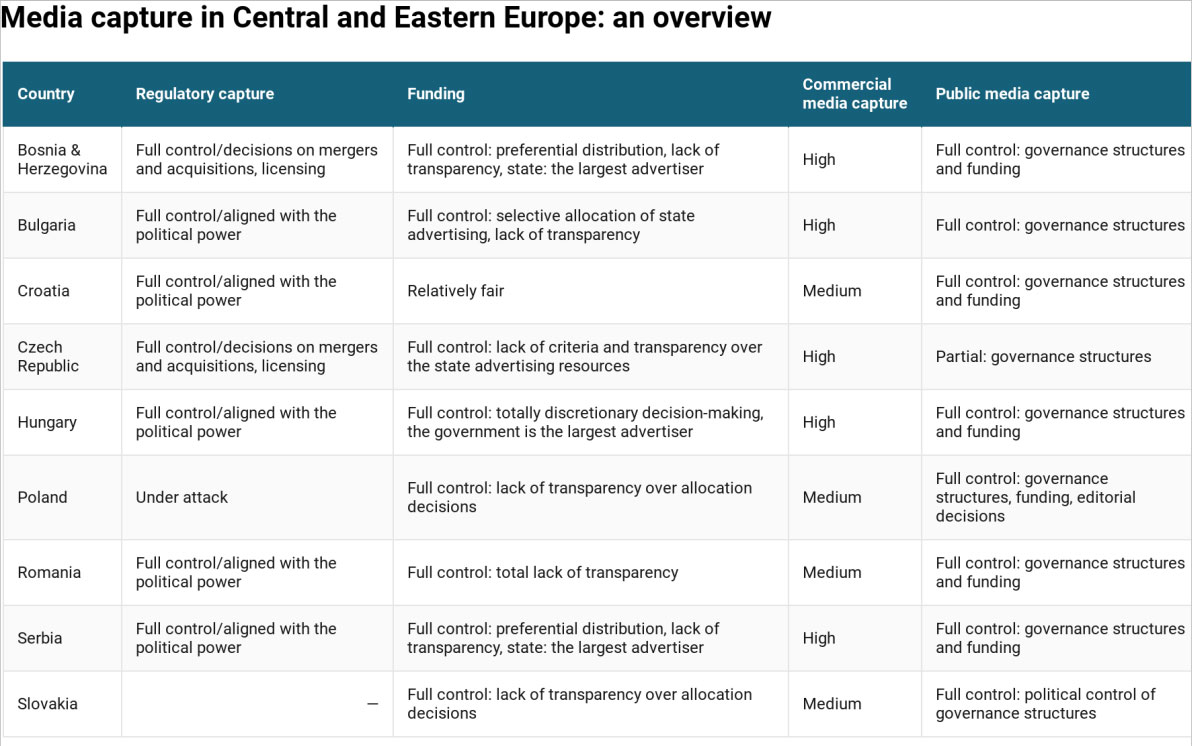 Notes:
* Dragomir proposes four dimensions for assessing the extent to which a government has captured the media: capture of regulatory agencies; government measures relating to funding; governmental capture of commercial media; and capture of public broadcasting.
* Central and Eastern European (CEE) countries provide prominent examples of contexts in which media capture has occurred on a particularly extensive scale over the past decade, as part of the broader phenomenon of democratic backsliding.
Bibliography
Audience Data Disclosure Bill, 5784-2024, P/4726/25.
Bajomi-Lazar, P., & Stępińska, A. (2019). The Hungarian media system under political pressure. Central European Journal of Communication, 12, 257-262.
Bar-Siman-Tov, I., Gan-Mor, G., Zeng, H., Mordechay, N., Rozai, Y., & Reshef, M. (2025). The timing of judicial review of the legislative process – Sometimes prevention is better than cure. ICON-S Essays: Essays in Public Law, Essay No. 3 of 2025. https://papers.ssrn.com/sol3/papers.cfm?abstract_id=6221678
Barhum, S. (2026). The new journalism and judicial review: A dual classification of journalists. University of Haifa.
Ben-David, A., Tsuriel, K., Tausig, S., Agari, H., Gatenio, S., & Boaz, H. (2025). The Israeli Free Press Index: On the brink of the abyss – How press freedom is affected by democratic backsliding in Israel. The Open University of Israel, The Seventh Eye, and the Van Leer Jerusalem Institute. https://www.vanleer.org.il/wp-content/uploads/2025/12/TEHOM_5-1-26_WEB.pdf
Benedek, I. (2024). Transforming the political public sphere: The media system of the Orbán regime in Hungary. Partecipazione e Conflitto, 17, 469-489.
Bermeo, N. (2016). On democratic backsliding. Journal of Democracy, 27, 5-19.
Bill on Preventing Harm by a Foreign Broadcasting Body to State Security (Temporary Provision – Swords of Iron), 5784-2024.
Bill on Preventing Harm by a Foreign Broadcasting Body to State Security (Temporary Provision – Swords of Iron) (Amendment – Enforcement and Extension of the Temporary Provision), 5784-2024.
Bill on Preventing Harm by a Foreign Broadcasting Body to State Security (Temporary Provision – Swords of Iron) (Amendment – Extension of Validity), 5784-2024.
Bill on Preventing Harm by a Foreign Broadcasting Body to State Security (Temporary Provision – Swords of Iron) (Amendment – Prevention of Broadcasts), 5784-2024.
Bolet, D., & Foos, F. (2025). Media platforming and the normalisation of extreme right views. British Journal of Political Science, 55, 1–25. https://doi.org/10.1017/S0007123425000195
Çelik, B., Radl, M., Ribac, M., Toth, F., & Turnšek, T. (2024). The structural and temporal curb of populism: A cross-country analysis of authoritarian populist influences on journalism. Journalism Studies, 25(16), 1990–2010.
Commissioner for Human Rights (2021). Memorandum on freedom of expression and media freedom in Hungary. Council of Europe. https://rm.coe.int/memorandum-on-freedom-of-expression-and-media-freedom-in-hungary/1680a1e67e
Culloty, E., & Suiter, J. (2021). Media control and post-truth communication. In A. Sajo, R, Uitz & S. Holmes (Eds.), Routledge Handbook of Illiberalism (pp. 365-383). Routledge.
Dragomir, M. (2019, May). Media capture in Europe. Media Development Investment Fund. https://www.mdif.org/wp-content/uploads/2023/10/MDIF-Report-Media-Capture-in-Europe.pdf
Ekström, M., Patrona, M., & Thornborrow, J. (2020). The normalization of the populist radical right in news interviews: A study of journalistic reporting on the Swedish democrats. Social Semiotics, 30(4), 466–484.
Globes. (2019, October 26). “We have to make sure you’ll be prime minister”: The Netanyahu–Mozes recordings revealed, and there is much more in them than a demand for positive coverage. Globes. https://www.globes.co.il/news/article.aspx?did=1001304677
Government Resolution 3661 of the 37th Government – Closure of the military radio station Galei Tzahal (December 22, 2025).
Gross, O., & Ní Aoláin, F. (2006). Law in times of crisis: Emergency powers in theory and practice. Cambridge University Press.
Haggard, S., & Kaufman, R. (2021). The anatomy of democratic backsliding. Journal of Democracy, 32(4), 27-41.
HCJ 61683-12-25 Movement for Quality Government in Israel v. Government of Israel (Nevo, February 2, 2026).
Hien, J., & Norman, L. (2023). Public broadcasting and democracy’s defense: Responses to far-right parties in Germany and Sweden. Democratization, 30, 1160-1181.
Holtz-Bacha, C. (2021). The kiss of death: Public service media under right-wing populist attack. European Journal of Communication, 36, 221-237.
Huq, A., & Ginsburg, T. (2018). How to lose a constitutional democracy. UCLA Law Review, 65, 78-169.
IDF Radio Privatization Bill, 5783-2022, P/178/25.
IDF Radio Privatization Bill, 5783-2023, P/2919/25.
IDF Radio Privatization Bill, 5785-2024, P/5141/25.
Israeli Public Broadcasting Bill (Amendment – Annual Report to the Knesset Economic Affairs Committee), 5783-2023, P/3776/25.
Israeli Public Broadcasting Bill (Amendment – Budget of the Israeli Public Broadcasting Corporation), 5784-2024, P/4736/25.
Israeli Public Broadcasting Bill (Amendment – Method of Appointing the Council of the Israeli Public Broadcasting Corporation), 5785-2025, P/5389/25.
Jackson, V. (2022). Knowledge institutions in constitutional democracy: Reflections on ‘the press’. Journal of Media Law, 14, 275-322.
Karniel, Y. (2025). Is media without provocation possible?. Kotz, 2.
Katz, E., & Liebes, T. (2009). “No more peace!”: How disaster, terror and war have upstaged media events. In N. Couldry, A. Hepp & F. Krotz (Eds.), Media events in a global age (pp. 32-42). Routledge.
Knutsen, C. H., Marquardt, K. L., Seim, B., Coppedge, M. Edgell, A. B., Medzihorsky, J., Pemstein, D., Teorell, J., Gerring, J., & Lindberg, S. I. (2024). Conceptual and measurement issues in assessing democratic backsliding. PS: Political Science & Politics, 57(2), 162-177.
Krzyżanowski, M., & Ekström, M. (2022). The normalization of far-right populism and nativist authoritarianism: Discursive practices in media, journalism and the wider public sphere(s). Discourse & Society, 33(6), 719–729. https://doi.org/10.1177/09579265221095406
Levi, Y., & Agmon, S. (2020). Beyond culture and economy: Israel’s security-driven populism. Contemporary Politics, 27, 292-315.
Little, A., & Meng, A. (2024). Measuring democratic backsliding. Political Science & Politics, 57, 149-161.
Lucas, E. (2022). How autocrats undermine media freedom. Journal of Democracy, 33, 131-146.
Lührmann, A., & Lindberg, S. I. (2019). A third wave of autocratization is here: What is new about it? Democratization, 26(7), 1095–1113.
Luo, Z., & Przeworski, A. (2023). Democracy and its vulnerabilities: Dynamics of democratic backsliding. Quarterly Journal of Political Science, 18(1), 105-130.
Neff, T., & Pickard, V. (2024). Funding democracy: Public media and democratic health in 33 countries. The International Journal of Press/Politics, 29, 601-627.
Nemeth, R. (2025). Media capture monitoring report: Hungary – Measuring EMFA compliance. IPI-MJRC Report I. https://ipi.media/wp-content/uploads/2025/12/HUNGARY-Media-Capture-Monitoring-Report-Overview-1.pdf
Manucci, L. (2017). Populism and the media. In C. Rovira Kaltwasser, P. Taggart, P. Ochoa Espejo & P. Ostiguy (Eds.), The Oxford handbook of populism (pp. 467–488). Oxford University Press.
McDevitt, M. (2022). Journalism and democratic backsliding: Critical realism as a diagnostic and prescription for reform. Political Communication, 39, 500-516.
McNeill, Z., & Clare, V. R. (2024). Freedom of the press in Hungary & the United States: A comparative review. City University of New York Law Review, 27, 1-25.
Över, D. (2021). Democratic backsliding and the media: The convergence of news narratives in Turkey. Media, Culture and Society, 43, 343-358.
Panievsky, A. (2022). The strategic bias: How journalists respond to antimedia populism. International Journal of Press/Politics, 27, 808-826.
Polyák, G. (2019). Media in Hungary: Three pillars of an illiberal democracy. In E. Połońska & C. Beckett (Eds.), Public service broadcasting and media systems in troubled European democracies (pp. 279-303). Routledge.
Połońska, E., & Beckett, C. (Eds.). (2019). Public service broadcasting and media systems in troubled European democracies. Routledge.
Public Broadcasting Corporation Privatization Bill, 5783-2022, P/181/25.
Public Broadcasting Corporation Privatization Bill, 5785-2024, P/5142/25.
Scheppele, K. L. (2018). Autocratic legalism. The University of Chicago Law Review, 85(2), 545–584.
Second Authority for Television and Radio Bill (Amendment – Revocation, Expiration or Suspension of a Broadcasting Franchise or Broadcasting License), 5783-2023, P/3769/25.
Second Authority for Television and Radio Bill (Amendment No. 49), 5784-2024, Government Bills 3268.
Štětka, V. (2015). The rise of oligarchs as media owners. In J. Zielonka (Ed.), Media and politics in new democracies: Europe in a comparative perspective (pp. 85–98). Oxford University Press.
Štětka, V., & Mihelj, S. (2004). The illiberal public sphere: Media in polarized societies. Palgrave Macmillan.
Štětka, V., & Mihelj, S. (2023). Media and illiberalism. In M. Laruelle (Ed.), The Oxford handbook of illiberalism (pp. 870-849). Oxford University Press.
Surowiec, P., Kania-Lundholm, M., & Winiarska-Brodowska, M. (2021). Towards illiberal conditioning? New politics of media regulations in Poland (2015–2018). East European Politics, 36, 27-43.
Szabó, G., Norocel, O. C., & Bene, M. (2018). Media visibility and inclusion of radical right populism in Hungary and Romania: A discursive opportunity approach. Problems of post-communism, 66, 33-46.
Węglińska, A., Szurmiński, Ł., & Wąsicka-Sroczyńsk, M. (2022). Politicization as a factor of shaping news in the public service media: A case study on public television in Poland. Athenaeum Polskie Studia Politologiczne, 72, 29-51.
Wolkenstein, F. (2022). What is democratic backsliding? Constellations, 30(3), 261–275.
Yadlin, A., & Klein-Shagrir, O. (2024). On political interests and self-serving diversity: How state policymakers envision public service media. The Communication Review, 28, 271-299.
Valentim, V. (2024). The normalization of the radical right: A norms theory of political supply and demand. Oxford University Press.
Rahmani, B. (2025). How autocrats use proxies to control the media. Journal of Democracy, 36, 92-105.
Rogenhofer, J. M., & Panievsky, A. (2020). Antidemocratic populism in power: Comparing Erdoğan’s Turkey with Modi’s India and Netanyahu’s Israel. Democratization, 27(8), 1394-1412.
Zonszein, M. (2024). The mainstreaming of Israeli extremism. Middle East Institute. https://mei.edu/publication/mainstreaming-israeli-extremism