
Anti-Media Media: Channel 14 as a Case Study for a New Model
مناهضة الصحافة: القناة 14 كحالة دراسة لنموذج جديد
Panievsky, A., Tausig, S. & Egri, C. (2026). Anti-Media Media: Channel 14 as a Case Study for a New Model. Media Frames, 28. https://doi.org/10.57583/MF.2026.28.10107
תקציר
העלייה במתקפות נגד חופש העיתונות ברחבי העולם והשימוש המניפולטיבי שעושים פוליטיקאים פופוליסטיים בכלי תקשורת מגויסים במטרה לפגוע בסביבת המידע הנחוצה לכל חברה ששואפת להיות דמוקרטית, מחייבים חוקרות וחוקרי תקשורת לפתח כלים להבחנה בין עיתונות – החוסה תחת הגנות חופש העיתונות – ובין ניסיונות מניפולטיביים להשתמש בחזות עיתונאית לשם הפצת שקרים, שנאה ותעמולה (Panievsky, 2025, 2026). במאמר זה מוצג ניסיון ראשון ליישם את הקונספט התיאורטי של “אנטי־עיתונות” באמצעות ניתוח תוכן של מדגם משידורי ערוץ 14. בניתוח מיושמים ארבעה קריטריונים מרכזיים לאפיון כלי תקשורת אנטי־עיתונאיים, החותרים תחת התפקידים המיוחסים לעיתונות בדמוקרטיה: (1) יחס לשקרים בני־הפרכה ותיאוריות קונספירציה; (2) הפצת שנאה, גזענות והסתה לאלימות; (3) יחס לעיתונאים וכלי תקשורת עיתונאיים; (4) הדהוד נטול ביקורת של תעמולה ממשלתית. מניתוח התוכן של מדגם משידורי ערוץ 14 במהלך שנת 2024 עולים הממצאים הבאים: ראשית, כל אחד מהקריטריונים לזיהוי אנטי־עיתונות הופיע ביותר מעשירית הפריטים במדגם. שנית, הקריטריון הדומיננטי ביותר, “הדהוד תעמולה ממשלתית”, הופיע בלמעלה מ־40% מהפריטים במדגם. אחריו, הקריטריון השכיח ביותר היה “שקרים בני־הפרכה”, שהופיע ב־34% מהתכנים. שלישית, תיאוריות קונספירציה בלתי מבוססות הופיעו בלמעלה מעשירית הפריטים במדגם, ובראשן תיאוריית הקשר שלפיה טבח שבעה באוקטובר הוא תוצאה של “בגידה מבפנים”. לבסוף, כפי שמאמר זה מדגים, המודל לזיהוי אנטי־עיתונות רלוונטי ואפקטיבי למקרה הישראלי. יהיה צורך בקידוד מבוסס תרבות כדי לשכלל את המודל ולהתאימו ליישום במדינות אחרות, אך הקריטריונים הבסיסיים, הנובעים מתפיסה נורמטיבית ביחס לתפקיד העיתונות בחברה דמוקרטית, נותרים בעינם. להבחנה זו משמעויות משפטיות, רגולטוריות ופוליטיות בנוגע לעתיד העיתונות וליכולת להגן עליה.
الملخص
إن تصاعد الهجمات على حريّة الصحافة حول العالم، والتوظيف التضليليّ لوسائل إعلام مجنَّدة من قِبَل سياسيّين شعبويّين بهدف الإضرار بالبيئة المعلوماتيّة الضروريّة لكلّ مجتمع يطمح للديمقراطيّة، يفرض على باحثي الإعلام تطوير أدوات للتمييز بين الصحافة – التي تقع تحت حماية حرّيّة الصحافة – وبين المحاولات التضليليّة التي تهدف إلى استغلال المظهر الصحفيّ من أجل نشر الأكاذيب، الكراهية، والدعاية (بانيفسكي، 2025، 2026).
يقدّم هذا المقال محاولة أولى لتطبيق المفهوم النظري لـ “مناهضة الصحافة”، وذاك من خلال تحليل محتوى عيّنة من بثّ القناة 14. يُطبّق التحليل أربعة معايير رئيسيّة لتوصيف وسائل الإعلام المناهضة للصحافة، والتي تقوّض الأدوار المنسوبة إلى الصحافة في النظام الديموقراطيّ: (1) الموقف من الأكاذيب القابلة للدحض ونظريّات المؤامرة؛ (2) نشر الكراهية، العنصرية، والتحريض على العنف؛ (3) التعامل مع الصحفيّين ووسائل الإعلام الصحفيّة؛ (4) الترديد الخالي من النقد للدعاية الحكوميّة.
كشف تحليل المحتوى لعيّنة من بثّ القناة 14 خلال عام 2024 النتائج التالية: أوّلًا، كلّ واحد من المعايير لتحديد مناهضة الصحافة ظهر في أكثر من عُشر الموادّ التحليليّة في العيّنة. ثانيًا، ظهر المعيار الأكثر هيمنة، وهو “ترديد الدعاية الحكومية”، في أكثر من 40% من موادّ العيّنة، تلاه المعيار الأكثر شيوعًا وهو “الأكاذيب القابلة للدحض”، والذي ظهر في 34% من المضامين. ثالثًا، ظهرت نظريّات المؤامرة التي لا أساس لها في أكثر من عُشر موادّ العيّنة، وعلى رأسها نظرية المؤامرة القائلة بأنّ مذبحة السابع من أكتوبر كانت نتيجة “خيانة من الداخل”.
أخيرًا، وكما يُوضِّح هذا المقال، فإنّ نموذج تحديد مناهضة الصحافة يُثبت ملاءمته وفعاليّته للحالة الإسرائيليّة. ستكون هناك حاجة إلى ترميز يراعي الخصوصيّات الثقافيّة لكلّ دولة لتحسين النموذج وملاءمته للتطبيق في دول أخرى، لكنّ المعايير الأساسيّة، النابعة من التصوُّر المعياريّ لدور الصحافة في المجتمع الديموقراطيّ، تظلّ قائمة. ويترتّب على هذا التمييز تبعات قانونية وتنظيميّة وسياسيّة وثيقة الصلة بمستقبل الصحافة والقدرة على حمايتها.
Abstract
The rise in attacks on press freedom worldwide, combined with the populist weaponization of partisan media to undermine our information environment, require that we develop tools for distinguishing journalism – which enjoys press freedom protections – from manipulative attempts to exploit the façade of journalism to spread falsehoods, hatred, and government propaganda (Panievsky, 2025, 2026). This article presents a first attempt to operationalize the theoretical concept “anti-media media”, by analyzing a sample of broadcasts from Israel’s Channel 14 during 2024. We apply four central criteria for identifying anti-media media that undermine the democratic functions attributed to journalism: (1) approach to false claims and conspiracy theories; (2) the dissemination of hatred, racism, and incitement to violence; (3) approach to journalists and newsrooms; and (4) the uncritical amplification of government propaganda. We find that, first, each of the four criteria appeared in at least one-tenth of the items. Second, the most prevalent criterion – the uncritical amplification of government propaganda – appeared in more than 40% of the items. The second most common criterion was verifiably false claims, which appeared in 34% of the sample. Unfounded conspiracy theories appeared in over one-tenth of the items, most notably the theory claiming that the October 7 massacre was the result of “treason from within”. Finally, this article demonstrates that the proposed model for identifying anti-media media is both relevant and effective in the Israeli case. Although local coding will be necessary to apply, refine, and adapt the model for use in other countries, the underlying criteria (derived from a normative conception of journalism’s role in a democratic society) remain. The distinction between journalism and anti-media media carries important legal, regulatory, and political implications for the future of news and the ability to protect it.
Introduction
Throughout the 20th century, media researchers and political scientists wrote extensively on the central role played by the media in establishing and shaping a democratic society. Mass media was considered an important tool in preserving and advancing liberal democracy through several key roles – from delivering vital information to the public to overseeing the government and power-holders (Curran, 2011; Gans, 1998; Overholser & Jamieson, 2005). However, in the first decades of the 21st century, the status of media outlets whose relationship with democracy is more complex, if not entirely antithetical, has risen. Unlike media outlets in which more and less professional journalists strive to ascertain the truth while cross-referencing sources and conducting journalistic investigations, to serve the public by exposing injustices and criticizing power centers, and to act independently and freely in order to reliably cover changing reality to the best of their ability and within external constraints – new media outlets, which are becoming increasingly dominant, maintain an entirely different relationship with these basic journalistic norms.
This article relies on the concept of “anti-media media” (Panievsky, 2025, 2026) to develop a model for identifying and assessing anti-media media outlets that exploit a news appearance and a journalistic façade – presenters in suits, a studio with a round table, news tickers at the bottom of the screen, etc. – for the systematic and conscious dissemination of falsehoods and conspiracy theories, the promotion of censorship and silencing of critical journalists and regime opponents, and the suppression of stories inconvenient to system loyalists. In practice, media outlets of this type serve as propaganda arms of a politician, party, or political camp, hiding behind the appearance of journalistic work while enjoying the protections intended to ensure a press free from political or commercial control, as well as the prestige and credibility attributed to journalistic media outlets (Panievsky, 2026, pp. 717-718).
The concept of anti-media media is a derivative of a phenomenon researched for years known as “anti-media populism” (Bhat & Chadha, 2020; Panievsky, 2021; Soriano & Gaw, 2022) – a concept describing populist movements, parties and politicians, that dedicate a significant part of their political agenda to attacks on journalists and newsrooms, even when using rhetoric of opposition to “the media.” Because there is no existing body of research in Hebrew dealing with “anti-media populism”, the term “anti-media media” is more successful and precise.
The distinction between journalistic and anti-medua media outlets is based on four levels: facticity, loyalty, pluralism and solidarity (Panievsky, 2026). (1) The level of facticity, meaning, the treatment of facts, stems from the informative role journalism plays in a democracy. What is the assessed media outlet’s approach to provable facts and unfounded claims? Are corrections published when errors are discovered in publication? What is the treatment of conspiracy theories? (2) The level of loyalty stems from the role of journalism as the “watchdog of democracy”. Who is the object of loyalty of the assessed media outlet? Is it committed to a specific party, a politician, a movement, an idea, a policy, a certain public, or the owners? And what motivates such loyalty – ideological identification, commercial considerations, loyalty to the public interest, or corruption? (3) The level of pluralism stems from the role of the media as a “marketplace of ideas”. Is space given to diverse opinions in the assessed media outlet? Specifically – is there room for opinions contrary to the source of the media outlet’s loyalty (a politician, party or idea)? (4) The level of solidarity stems from the role of the media in creating social cohesion and building an imagined community. What is the assessed media outlet’s approach to hate speech and incitement? How are racism and violence covered? Is representation given to diverse communities in society?
This article presents a first attempt to apply the theoretical concept of anti-media media. To examine its degree of utility, we will address the empirical case study of Channel 14. We will develop here four key criteria for characterizing anti-media media outlets that undermine the roles attributed to journalism in research. The first criterion stems from the factual level: treatment of refutable falsehoods and conspiracy theories, before and after publication. The second criterion stems from the solidarity level: dissemination of hatred, racism, and incitement to violence. The third criterion stems from the pluralism level: treatment of journalists and journalistic media outlets. The fourth criterion stems from the loyalty level: uncritical echoing of government propaganda.
This is an original model based on the theoretical concept of anti-media media (Panievsky, 2026), intended to develop ways to apply it in research and content analysis of existing media outlets. It aims to fill a gap in media research, which struggles to contend with the rise of a new type of journalism – one that does not belong to the various categories of objective journalism but is also not party journalism with an explicit ideological agenda; rather, it operates according to an entirely different set of values, a separate epistemic conception, and an ethos that is not a journalistic ethos. This is a major challenge, and a single article cannot answer all questions and resolve all dilemmas involved in it; we hope that the original contribution presented here will assist other researchers in deepening understanding regarding this prominent phenomenon.
The article will focus on Channel 14 as a case study, analyzing the content broadcast on it according to criteria derived from the extensive scholarly literature on the social roles of journalism, and specifically from new research on anti-media media. The channel, established in 2014 under the name “The Jewish Heritage Channel” (Channel 20), has been accused over the years of turning into an explicit propaganda arm of Netanyahu governments, using tools of incitement, manipulation, and fake news. Against the backdrop of Netanyahu’s criminal indictments, frequent election campaigns, the judicial overhaul, and the October 7 war, journalists and researchers warned that the channel consistently broadcasts incitement against opposition activists, hostage families, Palestinians, journalists, media outlets, and the leadership of the defense establishment, the judiciary, and the civil service, proudly encourages war crimes, and spreads conspiracy theories such as “treason”, “framed cases” and the “deep state” (Egri, 2024a; Persico, 2023, 2025a). Concurrently, Netanyahu governments rewarded Channel 14 (dating back to when it was called “Channel 20”) by exempting it from most regulatory obligations imposed on competing media outlets, effectively creating a separate regulatory system for it that grants benefits with an accumulated value of tens of millions of shekels, with even the state of emergency used as a pretext to grant it additional benefits (B”Z, 2022, 2024; Tausig, 2023). Relying on the literature addressing the social role of journalism, alongside a first-of-its-kind systematic examination of leading programs in Channel 14’s broadcast schedule in 2024, this article uses the Israeli case to establish the vital concept of “anti-media media”, acknowledge the threat it poses to society – especially during times of war or crisis – and propose an agenda for future research and policy.
Theoretical Background: Journalism and Other Falsehoods
Partisan Media in Research
In the past decade, academic research and public discussion surrounding the question of partisan media and media bias have flourished. In view of the strengthening of politically identified channels, especially in the United States, many researchers sought to document and analyze the characteristics of ideological bias in media content and its effects on viewers, public discourse, and voting patterns (Bauer et al., 2022; Levendusky, 2013a; Morris & Morris, 2022). Some even claimed that “partisan media has become the crucial component of the political media environment in the United States” (Druckman et al., 2019, p. 291; all translations are ours – A.P., S.T., C.E.).
The rich body of research dealing with partisan media (or hyperpartisan media) has focused over the past twenty years on several key issues. First, many researchers examined the link between biased media and the spread of disinformation and misinformation (Garrett et al., 2016; Simonov et al., 2022; Weeks et al., 2021), particularly following the Covid pandemic and the myriad conspiracy theories that accompanied it (Ash et al., 2024; Wu & Shen, 2022). Second, many researchers, in the United States and outside it, examined the link between biased media and an increase in political and affective polarization (Iyengar et al., 2019; Levendusky, 2013b; Martin & Yurukoglu, 2017; Stroud & Curry, 2015). Third, researchers asked what the connection is between the consumption of biased media and political awareness, participation in public life, and voting patterns (Broockman & Kalla, 2022; Casas et al., 2022; DellaVigna & Kaplan, 2007; Dilliplane, 2011; Suk et al., 2022; van Kempen, 2007). Alongside this, studies examined the connection between consuming biased media and damage to trust in mainstream media (Guess et al., 2021; Ladd, 2011), the creation of echo chambers and information bubbles (Bell et al., 2022; Jamieson & Cappella, 2008), and shaping the agenda of decision-makers and other media organizations (Arceneaux et al., 2016; Nygaard, 2021; Stevens & Allen, 2017).
In other words, many of the key and troubling issues in media research and political science today are tied to the question of partisan media and media bias. Another research strand focused on the history and annals of partisan media, primarily in the United States (Campbell, 2019; Kuypers, 2013; Ladd, 2011; Sheppard, 2007), even though partisan media existed in many countries over the years (Artz, 2026; Deacon & Wring, 2002; Labarre, 2024). In Israel too, a rich history of partisan media was written, mainly in the state’s early years (Meyers, 2005; Neiger, 2023; Soffer, 2014), before professional norms inspired by the journalistic ethos that grew in the United States in the 20th century were adopted (Markowitz-Elfassi et al., 2018; Peri, 2004; Tsfati & Meyers, 2012).
Yet despite the wealth of research in the field, the concept of “biased media”, or partisan media, remains vague. Most researchers in the field avoided providing a clear definition for it, or distinguishing between it and overlapping concepts such as advocacy media, political parallelism, or congruent media. Researchers who defined the concept of “biased journalism” included in this definition any media outlet deviating from the objectivity ethos of modern journalism as shaped in the United States in the early 20th century (Hackett & Zhao, 1998; Maras, 2012; Schudson, 1981). Jamieson and Cappella, for example, referred to biased media as media focusing on opinions instead of objective reports and being “ideologically consistent” (Jamieson and Cappella, 2008, p. 4). Druckman and colleagues described biased media as media that “avoids objectivity in favor of a specific point of view” (Druckman et al.,2019, p. 99). Arceneaux and Johnson used the term “ideologically slanted news” (Arceneaux et al., 2013, p. 227), and Levendusky concluded that “simply put, partisan media is opinionated media: media that not only reports the news but also offers a clear point of view on it” (Levendusky, 2013b, p. 2). Shultziner and Stukalin defined political bias as “presenting media products in a way that favors, criticizes, emphasizes, or minimizes a news story in accordance with political interests and ideologies” (Shultziner & Stukalin 2021, p. 373).
However, alongside this developing body of research, a phenomenon arose that exceeds the boundaries of coverage bias. Although media outlets can demonstrate various types of ideological bias on certain issues while upholding ethical rules and journalistic professionalism, in recent years we witness a growing phenomenon of media outlets crossing the lines from partisan, biased, or ideologically identified journalism into what will be termed here “anti-media media” (Panievsky, 2025, 2026). Later in the article, we will rely on theories dealing with the role of journalism in a democracy to develop a new model for distinguishing between journalism and anti-media media. We will illustrate the utility of this theoretical model through content analysis regarding an Israeli case study – Channel 14.
The Roles of Journalism in Democratic Societies in the 21st Century
Media researchers, political scientists, and political philosophers have produced an extensive body of research dealing with the connection between the institution of journalism and democratic society. In their recent book, James Curran and Joanna Redden summarize the primary roles attributed to media in liberal-democratic theory: (1) Informative role: Informing the public regarding current affairs so that they can participate in political life and vote for their preferred candidates; (2) Watchdog role: Serving as part of a system of checks and balances against power-holders in society, foremost among them the government; (3) Social role: Creating a shared imagined community, enforcing laws and norms, consolidating a shared identity, and creating a sense of closeness between people who have never met; (4) Public forum role: A stage or platform for conducting public debate and competition of ideas regarding the range of issues on the agenda (Curran & Redden, 2025). These roles have been discussed in the works of many media researchers over the years (Anderson, 2007; Bennett & Serrin, 2005; Carey, 1989; Carpentier & Wimmer, 2024; Curran, 2011; Rosen, 1999; Schudson, 2008, 2018; Strömbäck, 2005). These are the normative, ideal roles of mass media in a democratic society; their application, of course, is not optimal, and criticism of the performance of journalists and media outlets in democratic societies is longstanding, dynamic, and diverse (Goldstein, 2007; McChesney, 2004). Nevertheless, to assess the performance of media outlets in society and measure different types of media content in a systematic and coherent manner, clear and measurable criteria must be formulized.
The starting point of this study is that despite the many flaws in realizing the normative roles of journalism in a democracy, journalism remains a central – and even necessary – element in societies striving to maintain a democracy in the 21st century. This is a position based on the normative tradition of social responsibility, which emphasizes the informative, overseeing, and enabling roles of the media (Christians et al., 2010; Wyatt, 2007). This is not an unusual approach in media research, but it is also not self-evident: writing on journalism and democracy has coalesced over recent decades (Anderson, 2007; Starr, 2008), shifting from a positivist approach regarding the ability to reflect reality (Habermas, 1991; McNair, 2012), through a cynical and skeptical approach regarding the media’s ability to serve democracy (Baker, 2001; Usher, 2021; Zelizer, 2013), to attempts to show how journalism can serve democratic societies despite the flaws, errors, and failures along the way (Pickard, 2019; Schudson, 2018; Zelizer et al., 2022).
Most of the writing and research dealing with the roles of media in a democracy was created during the 20th century, when the information environment looked different – before the rise of smartphones, social media, algorithms routing the information environment, and various artificial intelligence developments. Today, any writing on democracy and information is required to address the dramatic change that occurred in the world of journalism following the rise in the use of social media to fulfill needs that mass media used to fulfill in the past.
In view of the dramatic changes in the information environment, and particularly the rise of social media as a channel for content consumption (news and other), the core roles of journalism in a democracy according to the liberal model – informing the public, overseeing power-holders, and creating a shared imagined community – have become even more vital and urgent. While algorithm-based social media constitute a reasonable partial substitute for the latter role (a public forum where public debate and competition of ideas regarding current affairs can be held), they clearly constitute a very poor substitute for the former roles of journalism in a democracy (providing reliable information, criticizing power-holders in society, and creating an imagined community at the national level). They promote ungrounded content, not based on the quality or reliability of the content or the speakers (Hameleers, 2020; Pickard, 2019; Tripodi et al., 2023; Tucker et al., 2018). They are built to highlight provocative and controversial content, as well as hate speech. In other words, they have the power to build communities around defined areas of interest, but they divide and polarize between them (Gerbaudo et al., 2023; Banaji & Bhat, 2022; Heltzel & Laurin, 2024; Lajevardi et al., 2022; Vasist et al., 2023). Moreover, major social media platforms have brought about a concentration of capital unparalleled in human history, and a dangerous proximity between a tiny number of multi-billionaires – whose algorithms, designed as they see fit, determine what information and opinions the public is exposed to – and leaders with authoritarian tendencies in various countries worldwide (Akbari, 2025; Fuchs, 2018). Thus, in the current decade, social media is reshaping the information environment, and while these platforms replace journalistic media outlets in the everyday life of users, their spirit, policy, and societal impacts do not align with the roles of journalism in a democracy, and are even diametrically opposed to them.
To measure the role of media outlets in advancing or regressing democracy, and specifically the fulfillment of the key roles of journalism as summarized above, we developed the model for identifying anti-media media. The purpose of this model is not only to label media outlets as journalistic, anti-media media, or along the journalistic spectrum, but also to contribute to struggles against attempts to use a journalistic cover (Panievsky, 2025, 2026) for the promotion and dissemination of falsehoods and conspiracy theories, political propaganda, hate speech, racism, and incitement to violence. Furthermore, it aims to assist organizations working for press freedom, courts, and political decision-makers in identifying which media outlets meet these parameters in a manner that entitles them to the protection of freedom of expression and press freedom, and grants them the prestige and credibility of journalistic media outlets.
Between Journalism and Anti-Media Media: Criteria for Distinction
The concept of “anti-media” refers to media outlets that use a journalistic cover to disseminate non-journalistic content, which contradicts the professional practices and roles of journalism in a democracy. “Journalistic cover” means the array of stylistic characteristics of news content adopted by anti-media media outlets: frame design, sound design, dress, intonation, color palette, headline design, fonts, and more. These are all those stylistic cues that researchers view as tools assisting the audience in assessing the credibility of the text (Rashkin et al., 2017; Panievsky, 2026). Stylistic elements can assist in evaluating a text’s level of credibility, and thus in the fact-checking process; many media literacy initiatives use stylistic characteristics of this type. Commercial actors discovered the power of these stylistic elements decades ago and use them frequently, for example in the field of covert advertising (sponsored content) that took hold in commercial journalism. Subsequently, various political actors also adopted this mode of action. Therefore, especially in the current information environment, there is room to address the question of professional boundaries and establish criteria for distinguishing between journalistic media outlets and others.
The model we propose here is based on the primary roles of journalism in democratic societies in the current information environment. Each of the criteria stems from one of the vital roles of journalism, for which press freedom must be protected in legislation and norms:
- Treatment of refutable falsehoods and conspiracy theories (contrary to the role of journalism to inform the public so it can participate in political life; related to the facticity level).
- Dissemination of hatred, racism, and incitement to violence (contrary to the social role of journalism in shaping an imagined community and shared identity, as well as the do no harm principle; related to the solidarity level).
- Treatment of critical and independent journalists and media outlets (contrary to the role of journalism as a public forum for conducting debate and competition of ideas regarding current affairs; related to the pluralism level).
- Echoing government propaganda (contrary to the role of journalism to criticize and oversee power-holders in society, foremost among them the government; related to the loyalty level).
In the next section, we shall detail the role of each of these criteria in distinguishing between journalistic and anti-media media outlets.
[1] Treatment of Refutable Falsehoods and Conspiracy Theories
The first criterion in the model we propose here is intended to capture the informative role of the media (Aalberg & Curran, 2011). To what extent does the assessed media outlet inform the public reliably regarding public life? This is not a simple criterion to apply, but it is critical. How do we determine what is factually accurate? To whom is authority granted to determine the level of accuracy and credibility of the media? And how can an effective index be created across varied platforms and contexts? In recent years, with technological development and given the ease of establishing news websites, new phenomena of journalistic impersonation have grown – adopting a journalistic facade to distribute anti-democratic content such as falsehoods, incitement, and propaganda (Panievsky, 2025, 2026). We rely here on the distinction between biased news websites and untrustworthy news websites: “Untrustworthy sites differ in that they offer content that is factually inaccurate, and are often designed to deliberately mislead their audience” (Guess et al., 2021).
When large tech companies attempted to deal with public criticism over the spread of falsehoods and conspiracy theories on their platforms, they turned to professional fact-checkers worldwide (Andersen & Søe, 2020; Bachmann & Valenzuela, 2023; Booth, 2025). Yet in recent years, even organizations seemingly intended to cross-reference information and ascertain facts were established by political actors in various countries to legitimize propaganda (Jackson, 2017; Lee, 2019). In our assessment, this methodological difficulty is one of the motives for the inflation of relative studies, which prefer examining media bias relatively – meaning, on the range between right and left – and not empirically, meaning, in relation to reality. However, even when such a relative index is applied optimally, it is not useful in identifying falsehoods or conspiracy theories, or in examining the connection between media documentation and reality on the ground. Despite the difficulty, we propose here a path to return the treatment of facts to center stage.
In recent years, various attempts were made to map the nature and scope of falsehoods distributed in media outlets. Thus, for example, during the Covid pandemic, Staender et al. (2024) analyzed over 1,600 posts posted on the Facebook pages of 25 alternative media organizations in five Western countries (France, Germany, Switzerland, Britain, and the United States). Based on this analysis, the researchers constructed a disinformation-focused codebook that distinguished between four types of false reporting: moderate bias, heavy bias, ideological misinformation, and extreme misinformation. In the cases examined in that study, moderate bias and heavy bias were the most common, while ideological misinformation and extreme misinformation were relatively rare. Below, we will examine if this is also the case with respect to Israel.
It is important to note that in any index examining a media outlet’s treatment of facts, refutable falsehoods, and conspiracy theories, one must rely on close familiarity with the researched context. As we will demonstrate below, in the case of Channel 14, our codebook was constructed based on in-depth, longstanding familiarity with the content broadcast on the channel and the conspiracy theories distributed on it (Egri, 2024a; Persico, 2023). The link between Channel 14 and unfounded conspiracy theories has been established previously: political psychology researchers Nimrod Nir, Nimrod Zeldin, and Asa Shapira surveyed a representative sample of the adult Jewish population in Israel after October 7, 2023 (alongside conducting a separate study among Arab society), and found that the conspiracy theory regarding “treason” – whereby elements in the “shadow state” in Israel were involved in the Hamas attack on the Gaza periphery communities – was spreading in Israeli society. Furthermore, they found an alignment between watching Channel 14 and believing in this conspiracy theory, even when controlling variables such as age, gender, and political stance (Persico, 2023).
Nevertheless, despite local nuances, the fundamental criterion we develop here – the treatment of refutable facts – crosses borders and cultures and may be useful in other languages, countries, and journalistic cultures as well. Even if the journalistic ethos and professional norms vary from country to country, the pursuit of representing reality tends to be sweeping (Mellado, 2020; Waisbord, 2013). Content analysis of the type we demonstrate below regarding Channel 14 is the way to examine a media outlet’s treatment of refutable facts and conspiracy theories.
[2] Dissemination of Hatred, Racism and Incitement to Violence
The second criterion for distinguishing between journalism and anti-media media is the media outlet’s approach to disseminating hatred, racism, and incitement to violence. This criterion addresses the social role of the media in consolidating an imagined community, enforcing laws and social norms, building a shared identity, and creating a sense of closeness between those who have never met (Anderson, 2008). Although this role is given relatively low weight compared to other social roles of journalism – such as informing the public on current affairs and overseeing power-holders – researchers agree that this is a central role of mass media. For those who doubt the importance of journalism’s role in shaping and formulating the “tribal campfire” or collective identity, sociologist Chris Anderson established an additional overarching journalistic principle relevant to media outlets spreading hatred, racism, or incitement: do no harm (Anderson, 2021). Anderson, writing on “journalism of fear” – a concept coined by political philosopher Judith Shklar – argues that journalists should see reducing cruelty in the world as their primary role, relying on the principle of preventing harm. Legally and ethically, media outlets in various countries are legally obligated to refrain from spreading hatred, racism, or incitement against an individual or group, and legal sanctions can be applied to journalists and media outlets doing so. In Israel, for example, the Prohibition of Defamation Law, 5725-1965, determines inter alia, that one must not “humiliate a person due to their race, origin, religion, place of residence, age, gender, sexual orientation, or disability”; and the Penal Law, 5737-1977, includes a “prohibition of publishing incitement to racism” regardless of whether the publication “led to racism or not, and whether it was true or not”. In the Rules of Professional Ethics of Journalism, approved by the plenum of the Press and Media Council (2020), it is also explicitly stated: “Journalists shall not publish anything that contains incitement or encouragement to racism.”
The use of media for purposes of incitement is a central, and sometimes primary, element in extremist movements and regimes. As shown by cases such as the Nazi Party’s use in Germany of radio broadcasts to spread hatred and propaganda before and during World War II, as well as the “Radio télévision libre des Mille Collines”, which was used to spread propaganda and incitement during the Rwandan genocide in the 1990s – the consequences of mobilizing media outlets to spread hatred toward various groups in society can be devastating (Bromley, 2011). In both of these historical cases, notable precedents were set when newspaper editors, news presenters, and even cartoonists who participated in disseminating racist hate propaganda and inciting violence were tried and punished by courts in Britain and Germany and international tribunals for participating in encouraging and inciting war crimes. In another case, Serbian radio station RTS (Radio Television of Serbia), used by Slobodan Milošević to spread propaganda and persecute regime opponents in the country in the 1990s, published an official apology in May 2011 stating that its broadcasts “harmed the feelings, moral integrity, and dignity of the citizens of Serbia, humanist intellectuals, members of opposition parties, journalists with a critical approach, various minorities within Serbia, as well as neighboring countries and peoples” (Tanjug, 2011).
However, identifying and measuring the dissemination of hatred, racism, and incitement to violence are not simple tasks. First, the legal definition of hate speech, racism, and incitement to violence is not universal, but varies from country to country. In Germany, for example, the legislature gave special attention to Antisemitic hate speech, in view of the history of the Holocaust and the extermination of Jews in the country (Glaun, 2021). In other countries, such as New Zealand, legislation against hate speech and hate crimes does not focus on Antisemitism, but on concepts more relevant to local history, such as racism or homophobia (Vergani et al., 2024). In some European countries, the treatment of traveler communities receives a prominent place in legal definitions of hate speech, whereas in Israel this is not a central issue (Vergani et al., 2024). The meanings and emphases regarding hate speech and incitement change from country to country and language to language. For instance, in Korea, a significant portion of online hate speech is based on affiliation with age groups, specific regions in the country, or specific religious communities (Ryu & Lee, 2025). This means that identifying hate speech requires mechanisms and researchers well-versed in local history and culture, and universal criteria cannot be set for it.
Second, as Austrian Antisemitism researcher Ruth Wodak writes, many messages of the populist right, based on the politics of fear, rely on “dog whistles” – content that is not explicit, but implied, requiring in-depth familiarity with the local context and culture to identify (Wodak, 2015). Hate speech and incitement to violence are not a fixed variable, but tightly bound to local culture and history. Without knowing the history of Antisemitism, for example, including prejudices toward Jews as an ethnic group and the traits attributed to them – which served to incite and spread hatred against them for centuries – it will be difficult to identify hints and references to those themes in contemporary content. The same applies to other minority groups, from Muslims in India to Afghan immigrants in Iran (Baider, 2023; Lindgren et al., 2024; Parvaresh, 2023; Wodak, 2015). In other words, any attempt to reliably, seriously, and systematically analyze and monitor hate speech in the media will require in-depth familiarity with the content, history, local culture, language, and its developing uses – both overt and implied.
Third, in attempts made in recent years to locate hate speech, racism, and incitement using AI-based tools, the task proved complex in other respects as well (Albladi et al., 2025; Fasching & Lelkes, 2025). For example, a study in which over a million sentences were reviewed to identify offensive content revealed that each of the large language models (LLMs) identified different sentences as containing hate speech. That is, identical sentences received different analyses when examined via Grok, ChatGPT, and others. In other words, despite the hope raised by the impressive capabilities of large language models to analyze massive datasets quickly, at this stage they cannot be used to identify hate speech without human intervention or supervision.
[3] Treatment of Journalists and Media Outlets
A third criterion distinguishing between journalistic and anti-media media outlets concerns the treatment of critical and independent journalists and media outlets. In the past decade, with increased vigor, many media outlets use a journalistic facade to attack and smear, often without factual basis, journalists and media outlets expressing criticism of the government or independence from its grip (Panievsky, 2025). Researchers in Eastern Europe described these media outlets as part of the “illiberal sphere”, and in Hong Kong as part of “anti-liberal journalism” (George, 2023; Štětka & Mihelj, 2024). These media outlets invest extensive broadcast time, resources, and energy in harsh criticism, escalating to defamation and sometimes incitement, not only against liberal values or their representatives in the public space, but also against journalists and media outlets carrying out their journalistic work. In some countries, they depend on public resources such as broadcast frequencies or licenses. In other countries, these media outlets – primarily websites and other low-cost production media – are funded by private donors, investors, or political operatives. However, this criterion does not address the ownership structures or commercial and political interests of the media outlet, but only the content they promote and their participation in undermining public trust and perceptions toward specific journalists, newsrooms, and “the media” as a collective concept (Ladd & Podkul, 2020; Panievsky et al., 2025; Van Dalen, 2021; Yamamoto et al., 2022).
Most research on the topic in the past decade focused on efforts by the political elite, especially in the populist right, to attack the media and intimidate it. Leaders such as Donald Trump, Benjamin Netanyahu, and Narendra Modi appear frequently in studies on their attempts to marginalize the media in their countries and reshape it (Adams, 2020; Boczkowski & Papacharissi, 2018; Carlson et al., 2022; Harrison & Pukallus, 2021; Lacatus & Meibauer, 2023; Panievsky, 2021; Rogenhofer & Panievsky, 2020). At the same time, limited attention was directed at the efforts of populist media to participate in that same campaign against journalism, and at times even lead it. Media outlets of this type – some affiliated directly with populist right-wing parties, some completely separate from them, and some maintaining non-transparent reciprocal relations with them – arose in several countries simultaneously. In India, for example, researchers dedicated attention to the attack on the media by the pro-Modi right-wing website OpIndia (Bhat & Chadha, 2020, 2022). As Singaporean researcher Cherian George wrote, these media outlets warrant far broader scholarly attention (George, 2023).
[4] Echoing Government Propaganda
The definitions proposed over the years for the concept of “propaganda” are numerous and varied. Interest in this concept flourished in the United States in the mid-20th century, waned toward its end, and is currently enjoying renewed interest, at times under the heading of “disinformation” or “fake news” (Sotirovic, 2019). However, a clear, agreed-upon, and concrete distinction between journalism and propaganda was never made, neither in the journalistic field nor in the research field. In fact, attempts to restrict the journalistic profession according to a variety of criteria were perceived by some media researchers as “boundary work” – attempts to push outside the journalistic field new players who challenge the system, in order to preserve the status and authority of professional journalists (Carlson, 2016, 2018; Lewis, 2012; Nygaard, 2020; Revers, 2014). In the media itself, there is also traditional resistance to establishing defining and limiting criteria for “journalism” and “journalist,” for fear they will serve as a tool to restrict the press by the government or other external actors. Yet without distinguishing criteria, the manipulative use of a journalistic facade will continue to empower political actors seeking to replace journalistic scrutiny with political propaganda.
When a media outlet is used to disseminate propaganda of a party, politician, or any political movement, this stands in direct contradiction to the most important role of journalism in a democratic society: criticism of power-holders in society, foremost among them the government, as part of the system of checks and balances (Bennett & Serrin, 2005). Therefore, in the model we propose to distinguish between journalism and anti-media media, we address the systematic, uncritical echoing of government and political propaganda. Another relevant concept to consider in this regard is “political parallelism”. Political parallelism refers to a pattern of relationships in which media outlets systematically echo the views and agenda of specific political groups (Albuquerque, 2018). In the past, studies on political parallelism primarily dealt with media systems and media outlets directly owned by a party, as was common in some countries, for example in Israel in the initial decades following the establishment of the state (Hallin et al., 2025; Hallin & Mancini, 2004; Meyers, 2005; van Kempen, 2007). In recent years, however, researchers have documented attempts by politicians, such as outgoing Hungarian Prime Minister Viktor Orbán, to create politically mobilized media even without formal and direct party ownership (Bajomi-Lázár, 2013; Griffen, 2020).
In the United States, several researchers recently raised question marks regarding the definition of cable channel Fox News as a journalistic media outlet rather than a propaganda arm of the Republican Party or the MAGA movement (Bauer et al., 2022; Nadler & Bauer, 2019). This type of overlap, between the talking points of a politician or party and the content of a media outlet, requires a two-step analysis: first, analyzing the primary messages distributed by the relevant political actors in that period; and second, analyzing the content distributed in the media outlet to examine the degree of alignment between them. This is, of course, a limited index; without constraints of time or resources, there would be room to attempt identifying the coordinated “silences” of media outlets and the politicians they serve (for instance, what topic was not covered in the news edition because it did not align with the messages of the politician or party it supports). Additional indications that could enrich this complex-to-measure criterion include a media change of direction coinciding with a political change of direction. We will attempt to provide examples of this type of indication in the analysis of Channel 14 presented below.
Case Study: Channel 14 as a Flagship Example of Anti-Media MEdia
To demonstrate the model we developed for identifying and classifying anti-media media (Panievsky, 2026), we chose to use the case of Channel 14. Channel 14 is a good example of a media outlet that shelters under the protections of freedom of expression and press freedom, serves as a regular platform for the Prime Minister and other senior political figures in his circle, and claims the treatment, prestige, and credibility attributed to a journalistic media outlet. This is despite being accused of failing to fulfill the roles of media in a democratic society, and even demonstrably harming them: spreading conspiracy theories and falsehoods debunked in the past, echoing the changing messages of the Netanyahu administration, and spreading hate speech and incitement to violence against various groups in and outside Israeli society (see, for example: Persico, 2023, 2025a, 2025b).
Channel 14: History and Background
Channel 14 is an Israeli television channel owned by Yitzchak Mirilashvili, son of oligarch Michael Mirilashvili (B”Z, 2022). It was founded in 2014 under the name “Channel 20” as a dedicated channel for Jewish heritage broadcasting. The channel consistently violated license terms, according to which it was required to focus on religious and traditional broadcasting and refrain from engaging in news and current affairs to enjoy various regulatory benefits (such as exemption from structural separation, original production obligations, or permission to broadcast commercials). The serial violation of the license terms exposed Channel 20 to sanctions from the supervisory body, the Cable and Satellite Broadcasting Council. In 2015, the channel was fined 100,000 shekels after broadcasting an election rally of Benjamin Netanyahu, chairman of Likud and Prime Minister (B”Z, 2022). That same year, it was fined again, in the amount of 150,000 shekels, following the broadcast of news flashes without a license (B”Z, 2022). In 2017, a violation proceeding was initiated against it following the broadcast of a news interview with the Prime Minister (B”Z, 2022).
In 2018, Prime Minister Netanyahu advanced an amendment to the Second Authority Law – the supervisory body for commercial television channels that are not dedicated – that would allow Channel 20 to turn from a dedicated channel for religious and traditional affairs into a general channel focusing on current affairs and competing with Channels 12, 13, and 11 (B”Z, 2022; Tausig, 2023; Persico, 2023). In this amendment, the channel was defined as a “micro-channel,” and a temporary provision was applied to it exempting it from most regulatory obligations imposed on competing channels (Tausig, 2023; Persico, 2023). For example, it is exempt from the obligation imposed on other news channels to finance original productions to support the market for original film and television production. Furthermore, it was not required to establish a separate news company from the channel to moderate owner interference in broadcasts – unlike, for example, the Channel 12 News company separated from Keshet 12. In addition, the legislative amendment transferred supervision over the channel from the Cable and Satellite Council to the Second Authority – a shakier and weaker regulator (B”Z, 2020, 2022).
In the years that followed, Netanyahu governments renewed the temporary provision repeatedly, granting the channel cumulative benefits and concessions estimated to be worth at least tens of millions of shekels by exempting it from regulatory obligations such as paying for original productions, broadcasting from Jerusalem, license fees via payments to the Second Authority, establishing a separate news company, prohibition of cross-ownership, prohibition of full ownership, or rules regarding linear broadcasting on Idan Plus and OTT platforms (Egri, 2024a). Over the years, Netanyahu worked consistently to promote the channel to the broad public, both through direct promotion via his popular social media accounts and by turning it into the exclusive platform for interviews with the Prime Minister of Israel in the Israeli media (Egri, 2024a).
As part of the series of governmental benefits, in January 2021, Channel 20 became a primary broadcast channel. Its name was changed and it began broadcasting on channel slot 14 (Egri, 2024a). Since then, the channel has competed with the three central television channels in Israel: two commercial channels (12 and 13) and one public (Kan 11), which, despite the rise in use of social media and sectoral media, remain popular and influential sources of journalism and news in a country where the scope of news consumption has always been exceptionally high (Markowitz-Elfassi et al., 2018; Neiger, 2023). In June 2024, broadcasts of an additional news channel, i24NEWS, began on channel slot 15.
In January 2023, with the establishment of the sixth Netanyahu government and the start of the judicial overhaul, the channel’s popularity rose, after years in which ratings remained negligible despite concessions and benefits (Egri, 2024a). This was due, among other things, to meager investment in broadcast content – many times less than what is customary on competing channels; exclusive focus on low-budget studio content; and the complete absence of drama, comedy, or reality content. In average general ratings, Channel 14 fluctuates to this day between second and fourth place, because it does not broadcast reality or drama programs and due to the extreme nature of its content. However, in the news prime-time slot – critical regarding the connection between journalism and democracy – it is regularly in second place in viewership numbers in Israel, after market-leading Channel 12.
Throughout all these years, the channel enjoyed the favor of the regulator and legislature, which exempted it from the rules and obligations binding its competitors, but also protection from the liberal camp in Israel, which sanctifies freedom of expression and press freedom. Thus, for example, an editorial in the liberal newspaper Haaretz (2022), under the headline “Leave Channel 14 Alone”, argued:
Channel 14 is not a model of journalism, to put it mildly, but nonetheless, there is no place for the petition by the Yesh Atid party against it to the Central Elections Committee. In Yesh Atid, they sought to declare the channel and its owner, billionaire Yitzchak Mirilashvili, as ‘active election entities’ and obligate them to ‘label’ their broadcasts as propaganda broadcasts.
In the years following 7 October 2023, government efforts to benefit Channel 14 continued through a series of legislative initiatives intended to contribute to promoting the channel and weakening its competitors (Gueta, 2026).
Research Design and Methodology
This study examines the content broadcast on the most-watched programs on Channel 14 during 12 randomly selected broadcast days in 2024. Such year was selected for two primary reasons: first, it being a fateful year in the history of the State of Israel, following the October 7 massacre and with the wars that ensued; and second, as a year in which a turning point occurred in the scope of the channel’s influence and visibility (B”Z, 2024; Wertheim, 2024; Cohen, 2023). The research corpus includes 24 current-affairs and news programs and totals 275 items broadcast on Channel 14 during 2024. In the study, all items broadcast on the two most-watched programs on each of the dates included in the sample were analyzed. The items were analyzed through viewing, based on the understanding that using written transcripts may miss emotional effects and visual components of importance for coding purposes (for example, in certain cases, the contrast between spoken content and accompanying visual content creates the complete effect).
The analysis relied on the criteria detailed above and their translation into concrete classification categories. After a pilot study in which two coders coded all items broadcast on two Channel 14 programs to ensure the codebook was relevant, useful, and effective, we built the sample. We chose to focus on one year – 2024. We randomly sampled 12 dates throughout that year (all on weekdays, since the channel does not broadcast on Saturdays; the full list of dates is attached in the appendix). Access to content included viewing programs recorded in the Channel 14 archive. On each date in the sample, all items in the two most-watched programs on the channel (mostly The Patriots1 and the Main Evening News) were analyzed. Every report, studio discussion, or opening monologue was considered an analysis unit. Each unit was marked with an identifying number, composed of the broadcast date and its position in the program sequence. In total, 275 items broadcast on Channel 14 during 2024 were analyzed.
The analysis of the items was conducted via thematic discourse analysis – a text-guided analysis method identifying recurrence of themes, categories, and key patterns in the research corpus (Boyatzis, 1998; Braun & Clarke, 2023; Fereday & Muir-Cochrane, 2006). The thematic discourse analysis was translated into numerical coding, enabling analysis of both key patterns in the coded content (for example, what conspiracy theories appeared in Channel 14 broadcasts in coded programs) and their dominance in the research corpus (for example, how dominant conspiracy theories were in coded items). This method combines qualitative and quantitative approaches to media content analysis, strengthening their advantages and reducing their disadvantages.
For the study, we built a codebook with analytical categories designed to anchor the theoretical model distinguishing between journalism serving democratic discourse and that harming it, or in other words, between journalism and anti-media. The codebook is divided into criteria translating the theoretical model into concrete distinctions: (1) Treatment of facts, refutable falsehoods, and conspiracy theories, before and after publication; (2) Dissemination of hatred, racism, and incitement to violence; (3) Treatment of critical and independent journalists and media outlets; (4) Uncritical echoing of government propaganda. The codebook includes questions such as: Does erroneous information appear in a given sampled item that can be refuted? Is any conspiracy theory mentioned in the item, and if so, which? Does hate speech or racism appear in the item, and if so, toward whom is it directed? Does explicit incitement to violence appear in the item?
Coding Falsehoods and Conspiracy Theories
Coders were instructed to code in this category only refutable empirical falsehoods and unfounded conspiracy theories, similar to the criterion used by Staender et al. (2024). In other words, statements such as “Netanyahu is an excellent prime minister” or “this is a period of miracles” were not coded here as refutable falsehoods, because these are impressions or opinions, not erroneous factual claims like incorrect reporting on public opinion polls or references to events that did not occur. Two questions in the codebook captured this criterion: “Do clear falsehoods appear in the item that can be refuted? (Possible answers: 0 No; 1 Yes; 2 Unclear/Hard to decide)”, and “Is a conspiracy theory mentioned in the item? (Possible answers: 0 No, 1 Yes – treason, 2 Yes – protesters and opposition are operated by foreign agents, 3 Yes – framing of Netanyahu’s cases, 4 Unclear/Hard to decide)”.
Coding Hate Speech, Racism, and Incitement
There are various ways to define and measure hate speech, racism, and incitement to violence. One accepted definition is any speech that “expresses, encourages, provokes, or incites violence against a group of individuals with a specific characteristic or set of characteristics, such as race, ethnic origin, gender, religion, nationality, or sexual orientation” (Parekh, 2012, p. 40).
In the codebook, we used two questions to capture this criterion, with the first focusing on hate speech in sampled items and the second on racism and incitement to violence. The questions were drafted in the codebook as follows: “Does hate speech or racism appear in the item? (Possible answers: 0 No, 1 Yes – against Palestinians, 2 Yes – against Arab citizens of Israel, 3 Yes – against left-wingers, protesters, and government opponents, 4 Yes – against the LGBT community, 5 Unclear/Hard to say)”, and “Does explicit incitement to violence appear in the item? (Possible answers: 0 No, 1 Yes – call for violence toward Palestinians, 2 Yes – call for violence toward Arab citizens of Israel, 3 Yes – call for violence against left-wingers, protesters, and government opponents, 4 Yes – call for violence against the LGBT community, 5 Unclear/Hard to say).
In both questions, the drafting of possible answers was based on in-depth, prolonged, and systematic prior viewing of Channel 14 content and close familiarity with the dominant content broadcast on it (Egri, 2024a), as well as on a pilot study in which two sample programs were coded to ensure the codebook was useful and relevant. Furthermore, in both questions, more than one category could be marked, as in many cases hate speech in the sample included references to more than one group (for example, Palestinians and also left-wingers, or the LGBT community and also protesters).
Coding Treatment of Journalists and Journalistic Media Outlets
Another key component in anti-medua media outlets in the current decade, as well as in the rhetoric of populist leaders, is a systematic attack on journalistic media outlets (Panievsky, 2026). Therefore, this category was coded based on the following question: “Does criticism of journalists, specific media outlets, or ‘the media’ in general appear in the item? Possible answers: 0 No, 1 Yes – legitimate criticism claiming the media is politically biased or factually mistaken, 2 Yes – unfounded criticism that is not inciting, 3 Yes – criticism comparing journalists or media outlets to enemies of the state and traitors, 4 Unclear/Hard to say”.
The goal here is to distinguish between legitimate media criticism, which is an important and even vital part of a functioning democracy; legitimate but erroneous media criticism, which aligns with the previous criterion of refutable falsehoods; and illegitimate criticism encouraging harassment and incitement against journalists and media outlets criticizing the government. Previous findings indicate that public opinion in Israel, particularly among Netanyahu supporters, echoes this type of delegitimization as well (Panievsky et al., 2024).
Coding Uncritical Echoing of Government Propaganda
This criterion was more complex to analyze, and was therefore examined in two stages. In the first stage, a thematic analysis (Braun & Clarke, 2023) was conducted of the key messages of Prime Minister Benjamin Netanyahu in the timeframe corresponding to our sample of Channel 14 broadcasts. To distill Netanyahu’s talking points during that period, his official statements – including speeches, press conferences, and press releases – were collected from the official YouTube channel of the Prime Minister of Israel.2 In total, 289 YouTube videos were analyzed. The central themes that emerged in the analysis are detailed in the Findings Chapter, and include, among others: describing Netanyahu’s trials as a “witch hunt”; media channels not loyal to Netanyahu as “panic channels”; the campaign in Gaza as one that will end in “total victory”; Hamas’s refusal as the sole obstacle to reaching a deal for the release of hostages from Gaza; military pressure as the exclusive means to return the hostages; and protesters against the war and the government as an “extremist and violent minority”.
After the qualitative classification of the central themes in government propaganda as they appeared in Netanyahu’s official statements, we moved to the second stage of analysis, the quantitative one, during which instances of these messages – without criticism or alternative journalistic framing – were coded in programs included in the sample. This coding was done alongside the coding of the other criteria, in the same Excel file. The alignment between messages issued by Netanyahu’s office and those broadcast on the most-watched programs on Channel 14 in the relevant period served us to demonstrate uncritical echoing of government propaganda.
Findings
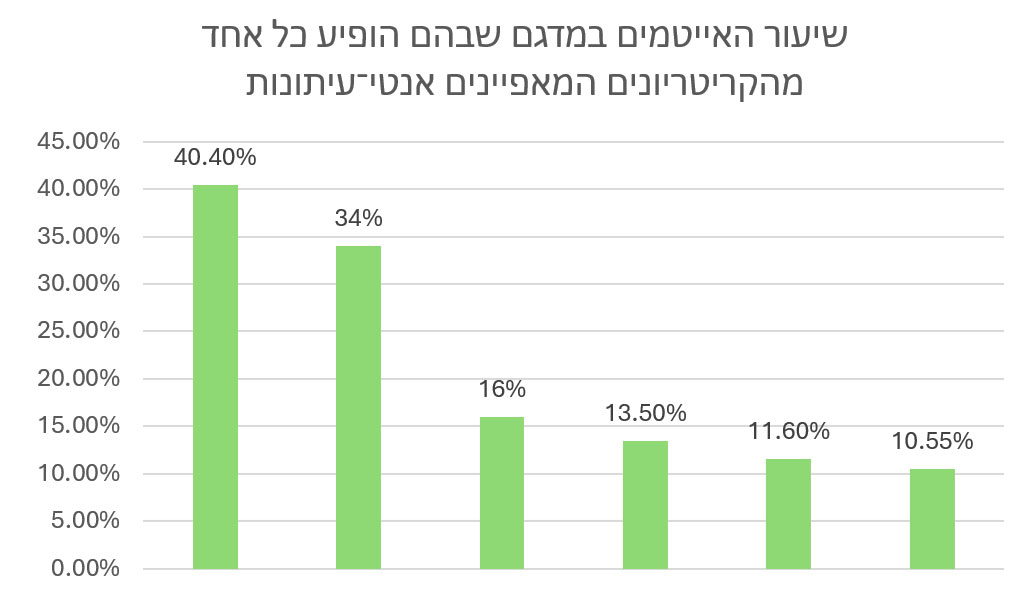 From right to left: conspiracy theories, incitement to violence, criticism of journalists, hate speech, falsehoods, propaganda.
In the findings chapter, we shall present descriptive statistics including the number and rate of items on Channel 14 that corresponded to the four categories we developed for identifying anti-media media. The presentation of each criterion will be accompanied by sample quotes from the materials.
[1] Treatment of Facts, Refutable Falsehoods and Conspiracy Theories
In 34% (N=94) of the items, refutable false assertions were found, meaning, facts and not opinions or assessments, for which reliable contradicting information exists – which appeared across the 24 sampled programs. In this category, controversial opinions or unfounded positions were not counted, but only factual references to information already proven incorrect (for example, erroneous coverage of public opinion polls, references to events that did not take place, etc.).
Below are several examples of publishing facts that were coded as false: “Also regarding stopping the war, in every poll, it’s a very small percentage of the people of Israel. The people of Israel are much more determined than the IDF Spokesperson’s appearance tonight, regarding defeating Hamas, toppling Hamas, and destroying Hamas” (Yotam Zimri, The Patriots, 6 February 2024). Unlike what was said in the studio, polls consistently showed that the overwhelming majority in Israeli society – about 70 percent – supported the signing of an agreement to end the war (Deitch et al., 2025; Hermann et al., 2025; Kushmaro, 2025).
Another example concerned the claim that legislative initiatives to change the judicial system in Israel did not truly create a rift or fear among the people, and that these were the domain of a limited elite only. As Irit Linur claimed:
“I remind you, there were people walking around with the feeling that there is a rift in the nation, and that the nation is alarmed by the judicial reform. That was never the case, and certainly these things never were, paraphrasing the poet Rachel. There was television there, there were inversions of numbers there, there were strikes in academia and indoctrination, and people who entrenched themselves in all kinds of positions you can’t move them from (The Patriots, 20 March 2024).
Contrary to these statements, the attempt to pass a dramatic judicial reform sparked immense public protest in Israel, exceptional in scope, which lasted for long months and included, according to police estimates as well, millions of citizens (see, for example: Eliran & Deitch, 2023; Hermann & Anabi, 2023).
Furthermore, broadcasts on the channel claimed that protests against Israel on campuses in the United States are funded by entities funding “left-wing organizations” in Israel. According to Amir Ivgi, “the spreading protests on campuses in the United States are known for their anti-Israel and Antisemitic line. Now it turns out that the foundations behind the protests there also fund and transfer money to a series of left-wing organizations here in the country” (The Main Evening News, 8 May 2024). Yet unlike what was claimed in the studio, the report published by the US Congress, upon which the report ostensibly relied, refuted the claim, and the Trump administration even emphasized this (Klein & Bar-Meir, 2025).
In addition, in 10.55% of the items (N=27), conspiracy theories lacking factual basis appeared. These theories share a common premise: behind the scenes, there is a plot by many people and organizations acting secretly and maliciously to harm one politician: Benjamin Netanyahu.
The first theory recurring in the sample preceded October 7 and the war in Gaza – the “framed cases” theory regarding Netanyahu’s criminal charges. According to the theory, energetically promoted by Netanyahu himself, government ministers, his supporters, and his attorneys – the investigations and indictments against the Prime Minister are part of a “witch hunt” conducted by the Israel Police, the State Attorney’s Office, the Attorney General, and Israeli media, which involves hundreds of investigators, prosecutors, and journalists at all ranks, who for more than a decade maliciously, planned, and deliberately invented charges, biased witnesses, and fabricated evidence against Netanyahu to cut short his political career. Unlike specific claims regarding investigative failures and the like, which have support or basis, the “framed cases” theory contradicts known facts and reasonable logic, cannot be proven, and has never been provided with supporting evidence.
Thus, for example, the “framed cases” theory recurred in the sampled Channel 14 programs:
Netanyahu’s trial resumed today with the testimony of former National Fraud Unit commander, Assistant Commissioner Coresh Barnoor. The cross-examination, on its second day, dealt with Barnoor’s witch hunt in the Prime Minister’s cases and the approvals to open an investigation (Maggie Tabibi, The Main Evening News, 9 April 2024)
Listen, today I am truly sad. After the testimony we saw of Coresh Barnoor in the Netanyahu trial, it must be said with sorrow that a group of senior officials in Israel decided to oust a sitting Prime Minister, and committed all offenses and violations of the law in order to meet this task […] You cannot ignore this, truly; five hundred years from now when the history of the people of Israel is written, this will be remembered. It is simply a disgrace (Guy Bossi, The Patriots, 9 April 2024).
There is a system here that joined together as a conspiracy to topple a sitting Prime Minister (Yaki Adamker, The Patriots, 5 December 2024).
Let’s tell the truth, fine, it’s not the testimony and it’s not the war and it’s not bribery, all these cases are framed. All these cases are a witch hunt, all these cases are because his name is Netanyahu (Itamar Fleischmann, The Patriots, 5 December 2024).
Guy Bossi: I speak with many senior criminal attorneys, and all of them tell me, all of them, without exception, that Mr. Netanyahu and Elovitch are innocent in Case 4000. But they add that there is no chance this court will acquit them. But I want to say something from a bird’s-eye view. The conduct of the State Attorney’s Office in this case is a disgrace. It is a shame.
Irit Linur: It is criminal, Bossi.
[…] Guy Bossi: I appeal to Elyakim Rubinstein and Aharon Barak, stop this farce. What is happening here, the three judges don’t have courage. Let them grow balls, and do what they need to do – stop the crazy trial, this is unacceptable […] We must ask ourselves in fairness, how did it reach a situation where senior state prosecutors, senior investigators in Israel, believe with whole faith that the sitting Prime Minister is a demon, that he is a thief, that he is corrupt, without any evidence. Let it be clear, there was no evidence, they simply marked the target and shot the arrows. How the elite of the State Attorney’s Office and the elite of the police, that’s what they are (The Patriots, 20 March 2024).
The “framed cases” conspiracy is a local development of a conspiracy theory imported from the United States, that of “The Deep State” (Berg, 2023; Horwitz, 2022; Michaels, 2018). According to this theory, the country is not governed by elected officials, but by a secret network of civil service members (officials, judges, prosecutors, and more), academia, and the media, all acting in coordination against the elected leader and against the will of the people. This conspiracy theory takes various forms in different countries and periods, and was used among other things to spread Antisemitism (Berg, 2023). This is how the version of this conspiracy theory sounded in sampled Channel 14 broadcasts: “In the absolute end, there is a sovereign here who is not allowed to govern! There is an elected government here unable to govern because a gang of officials, strong and carrying a long tradition of statesmanship and all that talk, simply will not let it govern (Erel Segal, The Main Evening News, 5 December 2024).
In the sample of Channel 14 content, the theory also appeared in an Antisemitic context, whereby wealthy Jews are behind the protests against the war in Gaza at universities worldwide, for example: “Pritzker, Soros, and Gelman are the ones who funded the campus protests (Moshe Cohen Elia, The Patriots, 6 February 2024).
However, the most common conspiracy theory in our sample is that of “treason”. This too is a long-standing conspiracy theory, whose most famous appearance was in Nazi propaganda regarding the “stab in the back of the nation”, intended to explain failure in World War I. In Israel, the theory was born on October 7 itself, intended to explain the failure in repelling the Hamas attack. Netanyahu, his circle, and his supporters adopted it as part of the campaign to remove responsibility for the failure from the government, and as part of the preceding campaign to smear protest organizations against the judicial overhaul. According to the “treason” conspiracy, the Hamas attack on October 7 was the product of cooperation, passive or active, direct or indirect, between the murderous terrorist organization and Israeli “traitors from within”. The group included in this theory expanded over the war to include the top tier of the defense establishment and other parts of it, protest organizations, critical journalists, opposition representatives, and even families of hostages and murder victims who criticized the government’s conduct. In the sample from Channel 14 broadcasts, this was expressed, for example, as follows:
The restart for the state needs to be done from the deep state. Now, what is the deep state? People think it’s some High Court octopus like that, with all its arms: media, Mossad, Shin Bet, police, that’s all true. But that’s not the main thing. The deep state is an organic system. The High Court didn’t order Uri Sagi, a colonel, to remove me from the cockpit. It didn’t order the Chief of Staff to appoint that questionable inquiry committee, it didn’t order Blinken to tell him: I’m coming to meet you secretly, and it didn’t order General Toledano: listen, answer insolently to Minister Strook – rather, there is a system here functioning organically, consciously, masterfully, for 120 years already. And in the end, it reaches the same danger, when the Southern Command Chief, the Shin Bet Director, the Chief of Staff, and the Head of Military Intelligence sit and decide: we will not wake the Prime Minister (Shai Kalach, The Patriots, 28 February 2024).
The Air Force Commander closes ranks here with all the elites to launder the great crime committed against the Jewish people in 2023 by the likes of ‘Brothers in Arms’ and that is very troubling. I ask myself how much can we rely on the judgment of an Air Force Commander who acts as a link within an oiled system trying to carry out consciousness engineering, with authority (Moshe Cohen Elia, The Patriots, 18 July 2024).
In summary, in 34% (N=94) of the sampled items, refutable false assertions were found, and 10.55% of the items (N=27) included conspiracy theories lacking factual basis. This is an exceptionally high rate. On the spectrum mapped by Staender and colleagues, Channel 14 stands closer to the category of “extreme misinformation” than to the category of “moderate bias”, which is the most common on alternative news sites in Western countries (Staender et al., 2024).
[2] Dissemination of Hatred, Racism, and Incitement to Violence
In 16% of the sampled items (N=44), instances of hatred, racism, and incitement were identified. Most hate speech appearing on Channel 14 broadcasts was directed toward government opponents. Thus, for example, opposition politicians such as Members of Knesset Ofer Cassif and Yair Golan were labeled enemies of Israel:
Member of Knesset Ofer Cassif from the Joint List, in another performance of solidarity with the enemy, launches an attack against Israel and accuses it of war crimes (Maggie Tabibi, The Main Evening News, 14 August 2024).
Have you learned nothing??? People were killed here! Women were raped, because of your madness! Your craziness, you destroyed a country! You, Yair Golan, are a criminal! The way you speak, you are a criminal, you are inciting, you are dismantling the State of Israel! You are a criminal individual who does not deserve to be in a democratic country! (Yinon Magal, The Patriots, 18 July 2024).
In some cases, attempts to portray opposition leaders as enemies of the state and haters of their people included additional groups in Israeli society, for example lecturers and researchers in universities:
What are the admission requirements to be junior or senior faculty? Being Antisemitic? The more Antisemitic you are, the more you are promoted? You see people who are genuinely, literally, terror supporters, and nevertheless they are in academia […] Those same people are also the ones who pass this content to the likes of Yair Golan and the IDF Spokesperson and feed it (Dror Kapach, The Patriots, 3 June 2024).
Alongside this, protesters against the Netanyahu government were labeled partners of the Hamas terrorist organization and other state enemies:
Sinwar sits, from the seventh of October, a few days later this campaign began marking Netanyahu as solely guilty, and all he does is rub his hands with pleasure and say thank you very much to whoever leads this campaign, thank you very much to whoever pumps it, thank you very much to whoever pours millions into billboards. And this is what these people need to know – that when we are fighting for our fate in the Land of Israel, for our right to exist, they go and give a gift to Sinwar and our greatest enemies in Gaza and the world (Yaki Adamker, The Patriots, 28 February 2024).
They also pass the content to the Americans, when someone needs to inform, as was the custom of certain Jews throughout history […] There was a name in history for those Jews (Yotam Zimri, The Patriots, 3 June 2024).
The idea is to create chaos, disrupt, harass, they don’t really care, not about the hostages, they want to topple the government, everything else is cynical use, whether it’s hostages, bereaved families, anything possible (Shai Goldstein, The Patriots, 20 March 2024).
You are a zealous, vengeful, irrelevant, petty camp, and I am so glad that it is simply composed of a bunch of losers – the country is not important to you! (Noam Fathi, The Patriots, 5 December 2024).
There will be no book, no text, and no seminar that does not address the role of the insubordinates in what happened to us on October 7th (Naveh Dromi, The Patriots, 28 February 2024).
Racism, primarily toward Palestinians, Muslims, and Arabs, also appeared in this category. For example: “The nations of the world are now in a process of Islamic conquest. We are talking about the Americans and the Europeans, and the entire Western world is now in a process of Islamic conquest” (Shai Goldstein, The Patriots, 20 March 2024); “Wherever there are Arabs, there will be terrorism against Jews. That is unequivocal, that I know” (Yotam Zimri, The Patriots, 14 August 2024).
In other cases, generalizing discourse of this type was directed toward world Jewry as well: “Jews in the Democratic Party are the biggest disaster for Israel, historically” (Dror Kapach, The Patriots, 14 August 2024); I don’t know how to break it to you, but most Jews in the US are on the side of the Muslims” (Yotam Zimri, The Patriots, 20 March 2024).
Furthermore, instances of incitement to violence, war crimes, and genocide in the Gaza Strip were identified in 11.6% of the items (N=32). For example, calls by broadcasters and reporters to halt humanitarian aid to the Gaza Strip appeared in the sample: “Here, I bring this: stop the humanitarian aid, stop the fuel, and stop the water” (Guy Bossi, The Patriots, 8 May 2024); Or to conquer the Gaza Strip and carry out ethnic cleansing as a means of punishment: “The enemy must pay in the currency that matters to them. Which is, of course, land” (Irit Linur, The Patriots, 20 March 2024). In other cases, broadcasters called to cancel the trial of soldier Shalev Golan, who was arrested after an indictment was filed against him for looting and taking weapons during his military service in the Gaza Strip.
Many cases of this type – and even far more severe – were documented, among other places, in petitions against Channel 14 and state authorities refraining from enforcing the law (Persico, 2025a, 2025b). In May 2025, civil society organizations and research institutes (The Democratic Bloc, Zulat Institute, and the Movement for Fair Regulation) filed a petition against the Israel Police, the State Attorney, and the Attorney General demanding the opening of a criminal investigation against Channel 14, claiming it broadcast “repeated statements constituting incitement to genocide, incitement to violence, and incitement to racism” (Persico, 2025b). For example:
In the first day or two we should have killed a hundred thousand [Gazans]… very few are perhaps human beings there. 90-something percent are terrorists and involved! Not involved, there is no such thing as not involved (Dani Neumann, The Main Evening News, 8 May 2024).
There are no innocents. Exactly that, when you say ‘population’, there is no population. There are two and a half million terrorists […] The moment there are no innocents in Gaza, there is no point to ‘roof knocking’. Because everyone is a terrorist (Eliyahu Yossian, The Patriots, 29 October 2023)
There are no innocent people. Fleischmann speaks constantly about the Nakba. In 48′ they brought the Nakba upon themselves. Now they will have a second Nakba, but a real one. To finish Ben-Gurion’s work (Naveh Dromi, The Patriots, 14 October 2023).
I expected much larger masses of killing among Hamas members and among the citizens of Gaza who are all, as we know, not ‘uninvolved’ (Dana Varon, The Patriots, 8 August 2024).
This is how all of Gaza should look, without one house, stone upon stone (Yinon Magal, The Patriots, 1 April 2024).
Any order that is not ‘anyone who comes near you will be eliminated’ is a patently illegal order […] No matter what the order is: you shoot to kill (Itamar Fleischmann, The Patriots, 1 October 2024).
In the response filed by the Israel Police with the court, it was claimed that the matter is under examination, but the examination will take an unknown amount of time. The findings from the sample examined here illustrate how prevalent this discourse was in the channel’s broadcast schedule during that period, and that it was not an exceptional finding in the channel’s content.
[3] Treatment of Critical and Independent Journalists and Media Outlets
In 13.5% of the items (N=37), criticism of journalists and media outlets identified as critical of the government appeared. In some, specific reporters were marked, in some, newsrooms were attacked, and in others, the entire Israeli “media” was targeted. Here too, a distinction was made between legitimate criticism and criticism of the type marking journalists and media outlets as enemies of the state, for example:
Israeli media is a parody. It is a media against its country. It is simply a wonderful thing (Yinon Magal, The Patriots, 9 April 2024).
What is happening in the media is truly, it’s like, one needs to deal with a counter-attack by the media against Israel. That is more or less the situation (Yinon Magal, The Patriots, 9 April 2024).
Only here, in some of the media outlets, do people struggle to part, if not from Hamas, then at least from the unclear addiction to defeatism (Tamir Morag, The Main Evening News, 6 February 2024).
One second, but I think you have an error in defining this discourse as defeatist. There is a difference between the things said here on the program and the things said in the media, or people like Yadlin who say this, because from the first moment they didn’t want to see Israel win. They have one hatred for one person, for Netanyahu, as long as he manages the war. As far as they are concerned, let Hamas win (Yaki Adamker, The Patriots, 9 April 2024).
What is happening in the media is simply a wondrous thing. All the terminology they use is a mind game, it is consciousness engineering, it is an unbelievable thing, I haven’t yet seen a thing as despicable as splitting a state memorial ceremony for a national disaster, I haven’t yet seen such a despicable thing, and the entire media cushions this event (Yinon Magal, The Patriots, 27 August 2024).
In 4.73% of the items (N=13), journalists and media outlets were compared to terrorist organizations, Nazis, Antisemites, and enemies of the state due to their journalistic activity. For example:
Amir Oren is ultimately one of many at the newspaper Haaretz who since October 7th simply do a terrible thing, harming our fighters, harming the State of Israel, harming the war we are managing against our greatest enemies. And here is the place to mention the thing that is nothing less than a disgrace and still happens after such headlines, which is the fact that the State of Israel still transfers millions of shekels annually to “Haaretz”, whether through subscriptions for senior IDF officialdom, whether through various advertisements via the Government Press Office or various other bodies, it is time for a newspaper that from within us, from within our people, causes this harm, to also stop this economic funding (Yaki Adamker, The Patriots, 28 February 2024).
This newspaper does damage. I am not calling to shut it down, okay? But I’m saying, there is a boundary between not shutting down a newspaper and starting to distribute it, for the state to distribute it via IDF bases and the like. If you want to read the newspaper and be Antisemitic, knock yourself out. There is no reason for the State of Israel to fund it, both through government advertising and through distribution to various government bodies, so the time has come for the Minister of Communications or the Minister of Defense, or whoever it may be, to put a stop to it (Dror Kapach, The Patriots, 14 August 2024).
Yotam Zimri: “Amira Hass is really, I already told you that I prefer pronouncing her last name differently […]”. Yinon Magal: “Here live happily Amira and Rudolf Höss” (The Patriots, 28 February 2024).
Anat Matar and Amira Hass can establish a party together – identifying with the enemy (Moshe Cohen Elia, The Patriots, 9 April 2024).
Regarding Ronen Bergman and the Barak Ravids of the world, I constantly raise this point: you are Israelis. Your supreme loyalty is here. Just because you work at The New York Times, you still identify as Israeli, it is simply troubling to see how much the work of our enemies is done many times by people from within (Moshe Cohen Elia, The Patriots, 18 July 2024).
In summary, attacks on media outlets and journalists appeared in over one-tenth of the items (13.5%), and almost 5% of all items in the sample included delegitimization of journalists and comparing them to terrorist organizations, Nazis, Antisemites, and enemies of the state.
[4] Uncritical Echoing of Government Propaganda
This criterion, as described in the methodological chapter, was examined in two stages. In the first stage, we checked what the primary messages of Prime Minister Netanyahu were in the months included in the sample. The analysis of government propaganda during 2024, relying on frequent press conferences and press releases from Netanyahu’s office published on the official YouTube channel of the Prime Minister of Israel, yielded the following key messages:
“Witch hunt”. Netanyahu’s criminal trial is “framed,” the product of a malicious plot by Netanyahu opponents: “This is an organized witch hunt” (Prime Minister’s statement, 10 November 2024); “I am waiting to expose the system of a cruel witch hunt […] The people are not stupid, they understood exactly what is happening here – political investigations and a political witch hunt” (Press conference, 9 December 2024).
“Panic channels”. The mainstream media broadcasts falsehoods and misleads the public to provoke polarization, panic, and fear: “Media fake news […] poison and panic in the midst of war” (Prime Minister’s statement, 10 November 2024).
“Total victory”. Netanyahu as supreme commander will end the war with the complete destruction of Hamas and not with an agreement with it: “We will achieve total victory” (Prime Minister’s statement, 20 May 2024); “I am more determined than ever to lead us to total victory” (Prime Minister’s statement, 10 November 2024).
“Hamas refusal”. Hamas is the sole and exclusive obstacle to signing a deal to release the hostages: “Israel is not the one preventing a deal. Hamas is preventing a deal” (Cabinet meeting, 7 April 2024); “Hamas is the one thwarting the release of our hostages” (Prime Minister’s statement, 5 May 2024); “The one preventing the release of our hostages is Hamas, which continues to oppose the framework, and not the Government of Israel, which accepted it” (Cabinet meeting, 4 August 2024).
“Military pressure will release hostages”: The hostages will be released specifically due to the continuation of the military campaign by Israel, and not through an agreement with Hamas: “The military pressure they exert here […] helps us advance the hostage deal” (Prime Minister’s statement, 18 July 2024); “Entering Rafah serves two central war goals: returning our hostages and eliminating Hamas. We already proved in the previous hostage release – military pressure on Hamas is a necessary condition for returning our hostages” (Prime Minister’s statement, 7 May 2024).
“Extremist and violent minority”. Whoever opposes the way Netanyahu manages the war, like hostage families and their supporters, are traitors from within who wish to disintegrate Israeli society:
At this moment, in the midst of the war, we must unite to repel the attacks against us. This is the time for unity. But precisely at this time, an extremist and violent minority is trying to drag the country into division. There is nothing our enemies want more. They wish for internal division and baseless hatred to stop us a moment before victory (Cabinet meeting, 7 April 2024).
In the second stage, the correlation between the messages of the Prime Minister’s Office and Channel 14 broadcasts in the same timeframe was examined.
In 40.4% of the sampled items (N=111), uncritical echoing or echoing without journalistic framing of key government messages of that period appeared. Furthermore, in one of the programs in the sample, an image video for Prime Minister Netanyahu was broadcast (The Patriots, 20 March 2024), without framing or criticism. In another case, news edition presenter Yinon Magal broadcast the program wearing a hat with the slogan coined by Netanyahu’s media advisors: “Total Victory” (The Patriots, 6 March 2024). This hat appeared on many programs on the channel, and Magal even attempted to sell such hats – an attempt cut short following complaints by the Movement for Fair Regulation and coverage of the initiative on The Seventh Eye website (Egri, 2024b).
Apart from external symbols, Netanyahu received sweeping compliments, exclusive credit for successes, and blind trust, at times avowedly:
First of all let us say, yesterday’s decision, the one who remained alone at the top and made the decision, with great boldness, with great courage, is Benjamin Netanyahu (Yaakov Bardugo, The Main Evening News, 31 July 2024).
I trust Netanyahu, even when he is under full anesthesia, more than I trust Gantz or Lapid (Yinon Magal, The Patriots, 1 April 2024).
I see how he [Netanyahu] defends the interests of the State of Israel, against all the weakening forces […] You can count on him (Yinon Magal, The Patriots, 18 July 2024).
I say wholeheartedly that I believe the Prime Minister, that if he asked Yoram Cohen to conduct wiretaps, it was only for state security, because state security was harmed because our senior officials have a big mouth (Erel Segal, The Main Evening News, 5 December 2024).
Alongside echoing Netanyahu’s messages, broadcasting propaganda videos on his behalf, and positive and praising commentaries, no criticism of the Prime Minister was heard in the sampled content. In the future, there is room to examine the possibility of refining the process and relying in this criterion on computerized text analysis, and perhaps even AI-based analysis. The primary task – identifying the degree of overlap between messages of the Prime Minister’s Office and messages of the media outlet – is a task matching the capabilities of large language models. This criterion could even be refined thanks to technological developments expected in the coming years.
Discussion
The findings raise several conclusions and several questions. First, it is evident that the criteria for identifying anti-media media – foremost among them falsehoods and government propaganda – were consistently and systematically present in Channel 14 content, both in the news edition and on The Patriots program. Yet Channel 14 is not an isolated case. In Israel, quite a few media outlets arose that operate similarly, raising concerns of anti-media media to varying degrees (for example, Israel Hayom, founded to promote Netanyahu [Benzaquen, 2015; Dahan & Bentham, 2017; Grossman et al., 2022], or later developments such as the Economic Channel owned by Yitzchak Mirilashvili, channel i24, or the planned Channel 16). The next stage will be relying on the criteria we designed to place them on the spectrum between journalism and anti-media media as well. Likewise, it will be possible to examine similar media outlets globally, in countries such as the United States, India, and Hong Kong, according to these criteria (Chadha & Bhat, 2022; George et al., 2025; Peck, 2019). Such a systematic examination could also answer the question raised by American media researchers Bauer and his colleagues: is Fox News a media outlet or a political machine? (Bauer et al., 2022).
Second, in terms of treatment of facts, it seems the Israeli case is more severe than those documented recently in other countries. As stated, Staender et al. (2024) distinguished between four types of false reporting appearing in alternative media outlets in France, Germany, Switzerland, Britain, and the United States: moderate bias, heavy bias, ideological misinformation, and extreme misinformation. In the cases examined in their study, primarily the first two, more moderate types of bias were found. Among alternative media outlets with moderate bias, for example, conspiracy theories were found in only 3% of content. A direct comparison cannot be made between the cases, which differ across varied parameters; however, the presence of conspiracy theories in over one-tenth of the content on Channel 14, which is a popular television channel and not a marginal news website, is an indication of the severe state of the information environment in Israel. Future research could examine the factors to which the severity of content on Channel 14 can be attributed compared to parallel media outlets in other countries: is the reason a lack of regulation? Government takeover of regulatory bodies? The extreme affective polarization in Israel? And perhaps Netanyahu’s ongoing war against critical journalism?
Third, an alarming rate of items in which instances of hatred, racism, and incitement were identified, was found (16%), and particularly hate calls against Palestinians in the Gaza Strip, including incitement to violence, war crimes, and genocide (11.6%). The content itself, and the examples brought in the article, are also difficult to digest. It will be interesting to examine further whether now, almost three years after October 2023, the rate of hate instances on the channel has decreased, or if only the mix of its targets changed (for example, more hatred toward protesters, less hatred toward Gazans). While many studies monitor and analyze hate speech on social media, and even use AI-based tools to shorten monitoring work, limited research attention has so far been directed at monitoring and analyzing expressions of hatred, racism, and incitement in media outlets. In view of democratic backsliding in many countries worldwide and the rise in populist authoritarianism, there is room to deepen our knowledge on the dissemination of hatred and incitement in media outlets, and not only on social media.
Conclusion
The rise in attacks against press freedom worldwide, and the manipulative use by populist politicians of mobilized media outlets to harm the information environment required for any society striving to be democratic, obligate the journalistic world – both journalists and media researchers – to develop tools to distinguish between journalism and manipulative attempts to use a journalistic facade to disseminate falsehoods, hatred, and propaganda (Panievsky, 2025, 2026). This article takes a first step in this needed direction, attempting to develop indices that will assist in placing media outlets on the spectrum between journalistic media outlets and media outlets masquerading as such to spread disinformation, propaganda, and hatred (Damstra et al., 2021; George, 2023; Palau-Sampio, 2023). The contribution of this article relates to two levels: first, formulating four criteria for identifying anti-media media outlets, and second, demonstrating the utility of this model through the case of Israeli Channel 14.
We began by presenting the criteria for distinguishing between journalism – intended to inform, criticize the government, create an imagined community, and provoke discussion on current affairs – and anti-media media, whose goals are entirely different, and at times opposite. The criteria we proposed are normatively based on the history of writing on the roles of journalism in societies striving to be democratic, and include: (1) treatment of refutable falsehoods and conspiracy theories; (2) dissemination of hatred, racism, and incitement to violence; (3) treatment of journalists and journalistic media outlets; (4) echoing government propaganda. We demonstrated the utility of the model for distinguishing between journalism and anti-media media through the case study of Channel 14. Through coding a sample of the channel’s broadcasts during 2024, we found that the rate of items in which all criteria for identifying anti-media media appear is exceptionally high, even in a comparative perspective. Each of the criteria appeared in over one-tenth of the items in the sample. The most dominant criterion, “echoing of government propaganda”, appeared in over 40% of the items. Following it, the most common criterion was “refutable falsehoods”, which appeared in 34% of the content. Unfounded conspiracy theories also appeared in over one-tenth of the items in the sample, led by the conspiracy theory claiming that the Hamas attack on October 7th was the result of “treason”. This finding provides further reinforcement for the findings of Nir and his colleagues, who conducted audience research and found an alignment between watching Channel 14 and believing in the conspiracy theory (Persico, 2023).
The model we proposed here is relevant and effective for the Israeli case. Culture-based coding will be necessary to refine it and adapt it for application in other countries, but the basic criteria, stemming from a normative view regarding the role of journalism in a democratic society, remain intact. Alongside the many challenges posed by new technologies – foremost among them AI-based large language models – to the journalistic profession and media researchers, there are also opportunities. In the context of the current study, we wish to direct attention to the potential inherent in using artificial intelligence tools to distinguish between journalistic and anti-media media outlets. This distinction has legal, regulatory, and political implications. Future research in different countries and journalistic cultures will be required to develop, sharpen, and improve the pioneering anti-media media index presented here.
Appendix 1: List of dates, 2024
6 February
28 February
11 March
20 March
9 April
8 May
3 June
18 July
31 July
14 August
27 August
5 December
*Since Channel 14 does not broadcast on weekends, the sample refers to weekdays only.
הערות
- In 2020, following complaints regarding the content broadcast on the program The Patriots, the Cable and Satellite Broadcasting Council instructed the channel to add a disclaimer to the program whereby “The program The Patriots is a current affairs program that may contain satirical content. To the extent that satirical content is integrated into the program, no other meaning or attempted harm shall be ascribed thereto”. At present, the program is defined on the channel’s website as a “daily satire program”, however, in practice, it features neither sketches nor satire, but rather functions as a current affairs program in every respect, with various commentators analyzing the day’s events.
- https://www.youtube.com/@IsraeliPM
Bibliography
Bibliography
Aalberg, T., & Curran, J. (Eds). (2011). How media inform democracy: A comparative approach. Routledge.
Adams, K. (2020). Between Trump and a hard place: Civil gatekeeping and moral equivalence in press endorsements of 2016 presidential candidates. Journalism Studies, 21(11), 1531–1550. https://doi.org/10.1080/1461670X.2020.1770118
Akbari, A. (2025). Big Tech authoritarianism: Political synergies of an emerging power. Dialogues on Digital Society, 1(3), 317–321. https://doi.org/10.1177/29768640251370968
Albladi, A., Islam, M., Das, A., Bigonah, M., Zhang, Z., Jamshidi, F., Rahgouy, M., Raychawdhary, N., Marghitu, D., & Seals, C. (2025). hate speech detection using large language models: A comprehensive review. IEEE Access, 13, 20871–20892. https://doi.org/10.1109/ACCESS.2025.3532397
Andersen, J., & Søe, S. O. (2020). Communicative actions we live by: The problem with fact-checking, tagging or flagging fake news – the case of Facebook. European Journal of Communication, 35(2), 126–139. https://doi.org/10.1177/0267323119894489
Anderson, B. (2008). Imagined communities: Reflections on the origin and spread of nationalism. In S. Seidman & J. C. Alexander (Eds.), The new social theory reader (2nd ed.). Routledge.
Anderson, C. W. (2021). ‘A journalism of fear’. Journalism, 22(8), 1912–1928. https://doi.org/10.1177/1464884920913383
Anderson, P. J. (2007). Competing models of journalism and democracy. In P. J. Anderson & G. Ward (Eds.), The future of journalism in the advanced democracies. Routledge.
Arceneaux, K., Johnson, M., Lindstädt, R., & Vander Wielen, R. J. (2016). The influence of news media on political elites: Investigating strategic responsiveness in congress. American Journal of Political Science, 60(1), 5–29. https://doi.org/10.1111/ajps.12171
Arceneaux, K., Johnson, M., & Cryderman, J. (2013). Communication, persuasion, and the conditioning value of selective exposure: Like minds may unite and divide but they mostly tune out. Political Communication, 30(2), 213–231. https://doi.org/10.1080/10584609.2012.737424
Ash, E., Galletta, S., Hangartner, D., Margalit, Y., & Pinna, M. (2024). The effect of Fox News on health behavior during COVID-19. Political Analysis, 32(2), 275–284. https://doi.org/10.1017/pan.2023.21
Bachmann, I., & Valenzuela, S. (2023). Studying the downstream effects of fact-checking on social media: Experiments on correction formats, belief accuracy, and media trust. Social Media + Society, 9(2), 20563051231179694. https://doi.org/10.1177/20563051231179694
Baider, F. (2023). Covert Islamophobia and Antisemitism via conspiracy theory. In V. Guillén-Nieto, A. Doval Pais, & D. Stein (Eds.), From fear to hate: Legal-linguistic perspectives on migration (pp. 149–172). De Gruyter Mouton.
Baker, C. E. (2001). Media, markets, and democracy. Cambridge University Press.
Banaji, S., & Bhat, R. (2022). Social media and hate. Taylor & Francis. https://doi.org/10.4324/9781003083078
Bar-Zohar, I. (2020, May 4). Double sabotage by the political system in overseeing commercial media. The Seventh Eye. https://www.the7eye.org.il/371214 [in Hebrew]
Bar-Zohar, I. (2022, January 2). Netanyahu and Channel 20: The story of selective enforcement. The Seventh Eye. https://www.the7eye.org.il/440625 [in Hebrew]
Bar-Zohar, I. (2024, November 9). Exposed: Government advertising spend on Channel 14 surged after Netanyahu’s return to power. Shakuf. https://shakuf.co.il/53563 [in Hebrew]
Bauer, A. J., Nadler, A., & Nelson, J. L. (2022). What is Fox News? partisan journalism, misinformation, and the problem of classification. Electronic News, 16(1), 18–29. https://doi.org/10.1177/19312431211060426
Bell, A. M., DeSante, C. D., Gift, T., & Smith, C. W. (2022). Entering the “foxhole”: Partisan media priming and the application of racial justice in America. Research & Politics, 9(4), 20531680221137136. https://doi.org/10.1177/20531680221137136
Bennett, W. L., & Serrin, W. (2005). The watchdog role. In G. Overholser & K. H. Jamieson (Eds.), The press (pp. 169–188). Oxford University Press.
Bhat, P., & Chadha, K. (2020). Anti-media populism: Expressions of media distrust by right-wing media in India. Journal of International and Intercultural Communication, 13(2), 166–182. https://doi.org/10.1080/17513057.2020.1739320
Boczkowski, P. J., & Papacharissi, Z. (Eds). (2018). Trump and the media. The MIT Press.
Booth, R. (2025, January 8). ‘Dispiriting’: Factchecker reacts to Meta’s move to scrap role. The Guardian. https://www.theguardian.com/technology/2025/jan/08/dispiriting-a-factchecker-reacts-to-meta-facebook-move-to-scrap-role
Boyatzis, R. E. (1998). Transforming qualitative information: Thematic analysis and code development. SAGE.
Braun, V., & Clarke, V. (2023). Thematic analysis. In F. Maggino (Ed.), Encyclopedia of quality of life and well-being research (pp. 7187–7193). Springer. https://doi.org/10.1007/978-3-031-17299-1_3470
Bromley, R. (2011). Beast, vermin, insect – Hate media and the construction of the enemy: The case of Rwanda, 1990–1994. Brill. https://doi.org/10.1163/9789401200387_004
Broockman, D., & Kalla, J. (2022). The manifold effects of partisan media on viewers’ beliefs and attitudes: A field experiment with Fox News viewers. OSF Preprints. https://doi.org/10.31219/osf.io/jrw26
Carey, J. W. (1989). A cultural approach to communication. In Communication as culture: Essays on media and society (pp. 11–28). Routledge. https://doi.org/10.4324/9780203928912
Carlson, M. (2016). Metajournalistic discourse and the meanings of journalism: Definitional control, boundary work, and legitimation. Communication Theory, 26(4), 349–368. https://doi.org/10.1111/comt.12088
Carlson, M. (2018). Boundary work. In T. P. Vos, F. Hanusch, D. Dimitrakopoulou, M. Geertsema-Sligh and A. She (Eds.), The international encyclopedia of journalism studies. John Wiley & Sons. https://doi.org/10.1002/9781118841570.iejs0035
Carlson, M., Robinson, S., & Lewis, S. C. (2022). News after Trump: Journalism’s crisis of relevance in a changed media culture. OUP USA.
Carpentier, N., & Wimmer, J. (2024). Media and democracy. In democracy and media in europe. Routledge.
Casas, A., Menchen-Trevino, E., & Wojcieszak, M. (2022). Exposure to extremely partisan news from the other political side shows scarce boomerang effects. Political Behavior, 45, 1491–1530. https://doi.org/10.1007/s11109-021-09769-9
Chadha, K., & Bhat, P. (2022). Alternative news media and critique of mainstream journalism in India: The case of OpIndia. Digital Journalism, 10(8), 1283–1301. https://doi.org/10.1080/21670811.2022.2118143
Christians, C. G., Glasser, T. L., McQuail, D., Nordenstreng, K., & White, R. A. (2010). Normative theories of the media: Journalism in democratic societies. University of Illinois Press.
Cohen, I. D. (2023, March 9). Channel 14’s ratings are soaring, and not only thanks to Netanyahu and Distel Atbaryan. Haaretz. https://www.haaretz.co.il/gallery/media/2023-03-09/ty-article-magazine/.premium/00000186-c159-d247-a5ff-cb7f71c20000 [in Hebrew]
Curran, J. (2011). Media and democracy. Taylor & Francis.
Curran, J., & Redden, J. (2025). Understanding media. Penguin Press.
Damstra, A., Boomgaarden, H. G., Broda, E., Lindgren, E., Strömbäck, J., Tsfati, Y., & Vliegenthart, R. (2021). What does fake look like? A review of the literature on intentional deception in the news and on social media. Journalism Studies, 22(14), 1947–1963. https://doi.org/10.1080/1461670X.2021.1979423
Deitch, M., Shafran Gittleman, I., Gitlin, A., & Shani, G. (2025, October 21). “Swords of Iron” survey findings: October 2025. Institute for National Security Studies (INSS). https://www.inss.org.il/he/publication/survey-october-2025/ [in Hebrew]
DellaVigna, S., & Kaplan, E. (2007). The Fox News effect: Media bias and voting. The Quarterly Journal of Economics, 122(3), 1187–1234. https://doi.org/10.1162/qjec.122.3.1187
Dilliplane, S. (2011). All the news you want to hear: The impact of partisan news exposure on political participation. Public Opinion Quarterly, 75(2), 287–316. https://doi.org/10.1093/poq/nfr006
Druckman, J. N., Gubitz, S. R., Levendusky, M. S., & Lloyd, A. M. (2019). How incivility on partisan media (de)polarizes the electorate. The Journal of Politics, 81(1), 291–295. https://doi.org/10.1086/699912
Editorial Staff. (2022, October 3). Leave Channel 14 alone. Haaretz. https://www.haaretz.co.il/opinions/editorial-articles/2022-10-03/ty-article-opinion/.premium/00000183-98ba-ddae-a387-bbfa2f390000 [in Hebrew]
Egri, C. (2024a, September 17). Channel 14 is a new kind of threat to Israeli democracy. The Seventh Eye. https://www.the7eye.org.il/529152 [in Hebrew]
Egri, C. (2024b, June 7). A total win for Yinon Magal’s bank account?. The Seventh Eye. https://www.the7eye.org.il/521074 [in Hebrew]
Elran, M., & Deitch, M. (2023). The judicial overhaul and public resistance to it: To what extent will social resilience and national security be harmed?. Institute for National Security Studies (INSS). https://www.inss.org.il/he/publication/reform-and-social-resilience [in Hebrew]
Fasching, N., & Lelkes, Y. (2025). Model-dependent moderation: Inconsistencies in hate speech detection across LLM-based systems. In W. Che, J. Nabende, E. Shutova, & M. T. Pilehvar (Eds.), Findings of the Association for Computational Linguistics: ACL 2025 (pp. 22271–22285). Association for Computational Linguistics. https://doi.org/10.18653/v1/2025.findings-acl.1144
Fereday, J., & Muir-Cochrane, E. (2006). Demonstrating rigor using thematic analysis: A hybrid approach of inductive and deductive coding and theme development. International Journal of Qualitative Methods, 5(1), 80–92. https://doi.org/10.1177/160940690600500107
Fuchs, C. (2018). Digital demagogue: Authoritarian capitalism in the age of Trump and Twitter. Pluto Press.
Gans, H. J. (1998). What can journalists actually do for American democracy? Harvard International Journal of Press/Politics, 3(4), 6–12. https://doi.org/10.1177/1081180X98003004003
Garrett, R. K., Weeks, B. E., & Neo, R. L. (2016). Driving a wedge between evidence and beliefs: How online ideological news exposure promotes political misperceptions. Journal of Computer-Mediated Communication, 21(5), 331–348. https://doi.org/10.1111/jcc4.12164
George, C. (2023). Left or right, reactionary anti-liberal media are worth closer study. Journalism & Communication Monographs, 25(4), 365–369. https://doi.org/10.1177/15226379231201457
Gerbaudo, P., De Falco, C. C., Giorgi, G., Keeling, S., Murolo, A., & Nunziata, F. (2023). Angry posts mobilize: Emotional communication and online mobilization in the Facebook pages of Western European right-wing populist leaders. Social Media + Society, 9(1), 20563051231163327. https://doi.org/10.1177/20563051231163327
Glaun, D. (2021). Germany’s laws on Antisemitic hate speech and Holocaust denial. PBS. https://www.pbs.org/wgbh/frontline/article/germanys-laws-antisemitic-hate-speech-nazi-propaganda-holocaust-denial/
Goldstein, T. (2007). Killing the messenger: 100 years of media criticism (revised edition). Columbia University Press.
Guess, A. M., Barberá, P., Munzert, S., & Yang, J. (2021). The consequences of online partisan media. Proceedings of the National Academy of Sciences, 118(14), e2013464118. https://doi.org/10.1073/pnas.2013464118
Guetta, Y. (2026, April 26). Channel 14 has already become a cash machine — so why does it keep getting perks and breaks?. TheMarker. https://www.themarker.com/news/themedia/2026-04-26/ty-article/.premium/0000019d-c55d-db3c-a1ff-d7fd1e7a0000 [in Hebrew]
Habermas, J. (1991). The structural transformation of the public sphere: An inquiry into a category of bourgeois society (T. Burger, Trans.). MIT Press.
Hackett, R. A., & Zhao, Y. (1998). Sustaining democracy?: Journalism and the politics of objectivity (2nd ed.). University of Toronto Press.
Hallin, D. C., Kitzberger, P., & Palos-Pons, M. (2025). Media anti-populism and political parallelism in Latin America. Annals of the International Communication Association, 49(2), 61–95. https://doi.org/10.1093/anncom/wlaf003
Hallin, D. C., & Mancini, P. (2004). Comparing media systems: Three models of media and politics. Cambridge University Press.
Hameleers, M. (2020). Populist disinformation: Exploring intersections between online populism and disinformation in the US and the Netherlands. Politics and Governance, 8(1), 146–157. https://doi.org/10.17645/pag.v8i1.2478
Harrison, J., & Pukallus, S. (2021). The politics of impunity: A study of journalists’ experiential accounts of impunity in Bulgaria, Democratic Republic of Congo, India, Mexico and Pakistan. Journalism, 22(2), 303–319. https://doi.org/10.1177/1464884918778248
Heltzel, G., & Laurin, K. (2024). Why Twitter sometimes rewards what most people disapprove of: The case of cross-party political relations. Psychological Science, 35(9), 976–994. https://doi.org/10.1177/09567976241258149
Hermann, T., & Anabi, O. (2023, March 13). February 2023 survey: Rising support for all forms of protest against the Levin plan. Israel Democracy Institute. https://www.idi.org.il/articles/48227 [in Hebrew]
Hermann, T., Yohanani, L., Kaplan, Y., & Sapozhnikova, I. O. (2025, January 15). December 2024 survey: Majority of the public supports a comprehensive deal to release all hostages in exchange for ending the war. Israel Democracy Institute. https://www.idi.org.il/articles/57946 [in Hebrew]
Iyengar, S., Lelkes, Y., Levendusky, M., Malhotra, N., & Westwood, S. J. (2019). The origins and consequences of affective polarization in the United States. Annual Review of Political Science, 22(1), 129–146. https://doi.org/10.1146/annurev-polisci-051117-073034
Jackson, J. (2017, February 15). Fact-checkers are weapons in the post-truth wars, but they’re not all on one side. The Guardian. https://www.theguardian.com/media/2017/feb/15/fact-checkers-are-weapons-in-the-post-truth-wars-but-theyre-not-all-on-one-side
Jamieson, K. H., & Cappella, J. N. (2008). Echo chamber: Rush Limbaugh and the conservative media establishment. Oxford University Press.
Klein, A., & Bar-Meir, U. (2025, July 26). Did the Biden administration fund anti-government protest organizations to the tune of a billion dollars? The case is weak. Globes. https://www.globes.co.il/news/article.aspx?did=1001517085 [in Hebrew]
Kushmaro, D. (2025, July 11). Ulpan Shishi survey: Overwhelming majority of the public favors a single-phase deal and an end to the war in Gaza. Channel 12 News. https://www.mako.co.il/news-politics/2025_q3/Article-8201fd74a2af791026.htm [in Hebrew]
Lacatus, C., & Meibauer, G. (2023). Crisis, rhetoric and right-wing populist incumbency: An analysis of Donald Trump’s tweets and press briefings. Government and Opposition, 58(2), 249–267. https://doi.org/10.1017/gov.2021.34
Ladd, J. M. (2011). Why Americans hate the media and how it matters. Princeton University Press.
Ladd, J. M., & Podkul, A. R. (2020). Sowing distrust of the news media as an electoral strategy. In E. Suhay, B. Grofman & A. H. Trechsel (Eds.), The Oxford handbook of electoral persuasion (pp. 427–454). Oxford University Press. https://doi.org/10.1093/oxfordhb/9780190860806.013.17
Lajevardi, N., Oskooii, K. A. R., & Walker, H. (2022). Hate, amplified? Social media news consumption and support for anti-Muslim policies. Journal of Public Policy, 42(4), 656–683. https://doi.org/10.1017/S0143814X22000083
Lee, D. (2019, November 19). Election debate: Conservatives criticised for renaming Twitter profile ‘factcheckUK’. BBC News. https://www.bbc.co.uk/news/technology-50482637
Levendusky, M. (2013a). How partisan media polarize America. University of Chicago Press.
Levendusky, M. S. (2013b). Why do partisan media polarize viewers? American Journal of Political Science, 57(3), 611–623. https://doi.org/10.1111/ajps.12008
Lewis, S. C. (2012). The tension between professional control and open participation: Journalism and its boundaries. Information, Communication & Society, 15(6), 836–866. https://doi.org/10.1080/1369118X.2012.674150
Lindgren, E., Rönnerstrand, B., Rettenegger, G., Breitholtz, E., Cooper, R., & Sayeed, A. (2024). Coded appeals and political gains: Exploring the impact of racial dogwhistles on political support. Journalism & Mass Communication Quarterly, 103(2), 696–723. https://doi.org/10.1177/10776990241280373
Maras, S. (2012). Objectivity in journalism. Polity Press.
Martin, G. J., & Yurukoglu, A. (2017). Bias in cable news: Persuasion and polarization. American Economic Review, 107(9), 2565–2599. https://doi.org/10.1257/aer.20160812
McChesney, R. W. (2004). Our unfree press: 100 years of radical media criticism. The New Press.
McNair, B. (2012). Journalism and democracy: An evaluation of the political public sphere. Routledge.
Mellado, C. (Ed.). (2020). Beyond journalistic norms: Role performance and news in comparative perspective. Routledge.
Meyers, O. (2005). Israeli journalism during the state’s formative era: Between ideological affiliation and professional consciousness. Journalism History, 31(2), 88–97.
Morris, D. S., & Morris, J. S. (2022). Partisan media exposure, polarization, and candidate evaluations in the 2016 general election. Social Science Quarterly, 103(5), 1101–1112. https://doi.org/10.1111/ssqu.13182
Nadler, A., & Bauer, A. J. (2019). News on the right: Studying conservative news cultures. Oxford University Press.
Nygaard, S. (2020). Boundary work: Intermedia agenda-setting between right-wing alternative media and professional journalism. Journalism Studies, 21(6), 766–782. https://doi.org/10.1080/1461670X.2020.1722731
Nygaard, S. (2021). On the mainstream/alternative continuum: Mainstream media reactions to right-wing alternative news media. Digital Journalism, 9(10), 1398–1414. https://doi.org/10.1080/21670811.2021.1894962
Overholser, G., & Jamieson, K. H. (2005). The press. Oxford University Press.
Palau-Sampio, D. (2023). Pseudo-media disinformation patterns: Polarised discourse, clickbait and twisted journalistic mimicry. Journalism Practice, 17(10), 2140–2158. https://doi.org/10.1080/17512786.2022.2126992
Panievsky, A. (2021). Covering populist media criticism: When journalists’ professional norms turn against them. International Journal of Communication, 15, 2136–2155.
Panievsky, A. (2025). The new censorship: How the war on media is taking us down. Footnote Press.
Panievsky, A. (2026). Anti-media media: A normative approach to media positionality. International Journal of Communication, 20(17), 714–730.
Panievsky, A., David, Y., Gidron, N., & Sheffer, L. (2025). Imagined journalists: New framework for studying media–audiences relationship in populist times. The International Journal of Press/Politics, 30(1), 38–62. https://doi.org/10.1177/19401612241231541
Parekh, B. (2012). Is there a case for banning hate speech? In M. Herz & P. Molnar (Eds.), The content and context of hate speech (pp. 37–56). Cambridge University Press.
Parvaresh, V. (2023). Covertly communicated hate speech: A corpus-assisted pragmatic study. Journal of Pragmatics, 205, 63–77. https://doi.org/10.1016/j.pragma.2022.12.009
Penal Law, 5737-1977 (Isr.). https://fs.knesset.gov.il//9/law/9_lsr_311018.PDF [in Hebrew]
Persico, O. (2023, December 12). “Frequency of watching Channel 14 increases belief in conspiracy theories”. The Seventh Eye. https://www.the7eye.org.il/505158 [in Hebrew]
Persico, O. (2025a, February 12). Call for a criminal investigation against Channel 14 on suspicion of sedition and incitement. The Seventh Eye. https://www.the7eye.org.il/543343 [in Hebrew]
Persico, O. (2025b, December 14). Israel Police: Complaints of incitement to war crimes on Channel 14 under review. The Seventh Eye. https://www.the7eye.org.il/562727 [in Hebrew]
Press and Communications Council, Plenum. (2020, September). Code of ethics of the Press and Communications Council in Israel. https://fs.knesset.gov.il/25/Committees/25_ci_bg_5541045.pdf [in Hebrew]
Prohibition of Defamation Law, 5725-1965 (Isr.). https://fs.knesset.gov.il//5/law/5_lsr_208497.PDF [in Hebrew]
Pickard, V. (2019). Democracy without journalism? Confronting the misinformation society. Oxford University Press.
Rashkin, H., Choi, E., Jang, J. Y., Volkova, S., & Choi, Y. (2017). Truth of varying shades: Analyzing language in fake news and political fact-checking. In M. Palmer, R. Hwa, & S. Riedel (Eds), Proceedings of the 2017 Conference on Empirical Methods in Natural Language Processing (pp. 2931–2937). Association for Computational Linguistics. https://doi.org/10.18653/v1/D17-1317
Revers, M. (2014). Journalistic professionalism as performance and boundary work: Source relations at the state house. Journalism, 15(1), 37–52. https://doi.org/10.1177/1464884913480459
Rogenhofer, J. M., & Panievsky, A. (2021). Antidemocratic populism in power: Comparing Erdoğan’s Turkey with Modi’s India and Netanyahu’s Israel. Democratization, 28(8), 1394–1415. https://doi.org/10.1080/13510347.2020.1795135
Rosen, J. (1999). What are journalists for? Yale University Press.
Schudson, M. (1981). Discovering the news: A social history of American newspapers. Basic Books.
Schudson, M. (2008). Why democracies need an unlovable press. Polity.
Schudson, M. (2018). Why journalism still matters. Polity.
Shultziner, D., & Stukalin, Y. (2021). Politicizing what’s news: How partisan media bias occurs in news production. Mass Communication and Society, 24(3), 372-393.
Simonov, A., Sacher, S., Dubé, J.-P., & Biswas, S. (2022). Frontiers: The persuasive effect of Fox News: Noncompliance with social distancing during the COVID-19 pandemic. Marketing Science, 41(2), 230–242. https://doi.org/10.1287/mksc.2021.1328
Sotirovic, M. (2019). Propaganda and journalism. In M. Powers (Ed.), Oxford Research Encyclopedia of Communication (online ed.). Oxford University Press. https://doi.org/10.1093/acrefore/9780190228613.013.864
Staender, A., Humprecht, E., & Esser, F. (2024). Alternative media vary between mild distortion and extreme misinformation: Steps toward a typology. Digital Journalism, 12(6), 830–850. https://doi.org/10.1080/21670811.2024.2326928
Starr, P. (2008). Democratic theory and the history of communications. In B. Zelizer (Ed.), Explorations in communication and history (pp. 27–44). Routledge.
Štětka, V., & Mihelj, S. (2024). The rise of the illiberal public sphere. In V. Štětka & S. Mihelj (Eds.), The illiberal public sphere: Media in polarized societies (pp. 25–59). Springer Nature Switzerland. https://doi.org/10.1007/978-3-031-54489-7_2
Stevens, D., & Allen, B. (2017). When going to war is costly: A comparative study of audiences and the partisan press. The International Journal of Press/Politics, 22(3), 380–401. https://doi.org/10.1177/1940161217708065
Strömbäck, J. (2005). In search of a standard: Four models of democracy and their normative implications for journalism. Journalism Studies, 6(3), 331–345. https://doi.org/10.1080/14616700500131950
Stroud, N. J., & Curry, A. (2015). The polarizing effects of partisan and mainstream news. In A. Yoshinaka & J. A. Thurber (Eds.), American gridlock: The sources, character, and impact of political polarization (pp. 337–354). Cambridge University Press. https://doi.org/10.1017/CBO9781316287002.017
Suk, J., Shah, D. V., & McLeod, D. M. (2022). Breaking the “virtuous circle”: How partisan communication flows can erode social trust but drive participation. Human Communication Research, 48(1), 88–115. https://doi.org/10.1093/hcr/hqab015
Tanjug. (2011, May 24). State broadcaster “sorry” for 1990s. B92. https://www.b92.net/o/eng/news/politics-article?yyyy=2011&mm=05&dd=24&nav_id=74507
Tausig, S. (2023, February 7). Netanyahu grants Channel 14 benefits worth tens of millions of shekels. The Seventh Eye. https://www.the7eye.org.il/477999 [in Hebrew]
Tripodi, F. B., Garcia, L. C., & Marwick, A. E. (2023). “Do your own research”: Affordance activation and disinformation spread. Information, Communication & Society, 27(6), 1212–1228. https://doi.org/10.1080/1369118X.2023.2245869
Tucker, J. A., Guess, A., Barbera, P., Vaccari, C., Siegel, A., Sanovich, S., Stukal, D., & Nyhan, B. (2018). Social media, political polarization, and political disinformation: A review of the scientific literature (SSRN Scholarly Paper No. 3144139). Social Science Research Network. https://doi.org/10.2139/ssrn.3144139
Usher, N. (2021). News for the rich, white, and blue: How place and power distort American journalism. Columbia University Press.
Van Dalen, A. (2021). Rethinking journalist–politician relations in the age of populism: How outsider politicians delegitimize mainstream journalists. Journalism, 22(11), 2711–2728. https://doi.org/10.1177/1464884919887822
van Kempen, H. (2007). Media-party parallelism and its effects: A cross-national comparative study. Political Communication, 24(3), 303–320. https://doi.org/10.1080/10584600701471674
Vasist, P. N., Chatterjee, D., & Krishnan, S. (2023). The polarizing impact of political disinformation and hate speech: A cross-country configural narrative. Information Systems Frontiers, 26, 663–688. https://doi.org/10.1007/s10796-023-10390-w
Verthaim, D. (2024, December 17). Ratings briefing: Keshet 12 and Channel 14 climb, Reshet 13 keeps sinking. Walla. http://b.walla.co.il/item/3712422 [in Hebrew]
Waisbord, S. (2013). Reinventing professionalism: Journalism and news in global perspective. Polity.
Weeks, B. E., Menchen-Trevino, E., Calabrese, C., Casas, A., & Wojcieszak, M. (2021). Partisan media, untrustworthy news sites, and political misperceptions. New Media & Society, 24(12), 2765–2783. https://doi.org/10.1177/14614448211033300
Wodak, R. (2015). The politics of fear. Sage.
Wu, Y., & Shen, F. (2022). Exploring the impacts of media use and media trust on health behaviors during the COVID-19 pandemic in China. Journal of Health Psychology, 27(6), 1445–1461. https://doi.org/10.1177/1359105321995964
Wyatt, W. N. (2007). Critical conversations: A theory of press criticism. Hampton Press.
Yamamoto, M., Jo, H., & Ran, W. (2022). Anti-media expression by citizens: Conservative summary sites, hostile media perceptions, and media trust in Japan. Information, Communication & Society, 25(13), 1952–1968. https://doi.org/10.1080/1369118X.2021.1907436
Zelizer, B. (2013). On the shelf life of democracy in journalism scholarship. Journalism, 14(4), 459–473. https://doi.org/10.1177/1464884912464179
Zelizer, B., Boczkowski, P. J., & Anderson, C. W. (2022). The journalism manifesto. Polity.